Thursday, July 12, 2012

Yeosu World Expo 2012!

Last week we took the students on a post-exam field trip to the 2012 World Expo, which just happens to be taking place in the nearby port city of Yeosu (여수) located roughly 2 hours south of Gwangju. Despite the rain (and there was a lot of it. It managed to permeate my umbrella so that I was soaked through before I even made it to school to catch the bus!), it was a pretty cool day. This year's expo theme is "The Living Ocean and Coast", so what better place to host it than in a port city?


Excited students below Yeosu's Digital Aquarium
Rather than wandering around with the other teachers, I decided to tag along with different groups of students - definitely a wise choice, as getting to see the excitement on their faces at the aquarium was pretty awesome, as was watching their delight when they started catching crabs by the shoreline (I left some a group of boys after about 10 minutes of this only to return an hour later to find that, not only were they still there crab-hunting, they'd been joined by a great many of the other boys. Funnily, they kept complaining to me every time one of them got pinched by a claw :P).

Hunting for crabs.

Got one!

As we were only at the expo for 6 hours (shame, that, there is a great deal to see!), I didn't have the opportunity to check out too many of the national pavilions in the international area. Those which I did see and which are worth visiting included Japan, Switzerland and France. Japan's pavilion used animation to tell the story of hope after it's recent Tsunami-induced disaster. While the story is a bit contrived (there are English subtitles) the stunning 3D holographic animation in which it is told makes the experience breathtaking. There are long lines for this, so pick up your ticket (at the Japan pavilion) in advance. The Swiss exhibit was made wonderful by the inclusion of a glacial ice core and information surrounding environmental data collection. Definitely cool to see. France I just liked for the inclusion of jelly fish and a cute colourful aquarium at the entrance. 

An Ice Core as old as Korea at the Swiss Pavilion.

The French Pavilion.
My main focus of the day was on exploring the theme pavilions (and watching my students catch crabs). My two favourites of the ones I managed to explore were the Marine Industry & Technology Pavilion, which primarily involved a hilariously k-pop-y discussion of the benefits of kelp set in a future undersea laboratory (I got the feeling the presentation was mainly geared towards kids - English subtitles once again) and the Expo's 'Eco-Friendly' Aquarium containing 34,000 animals of 281 different species . While I'm not usually a huge fan of seeing animals in captivity and would have preferred to see the Baikal Seals and Belugas in larger tanks, the aquariums 360° Aquadome was fantastic. What can I say, I was won over by having sea turtles, hammerheads and a number of other large marine species swimming directly over, under and around me :).


Solar Panels at the Aquarium.

The reaction of my students when they realized that he was not, in fact, a statue.
(It involved a lot of excitement and screaming)

Their excitement at the solar-powered charging station.
Our faces projected onto the aquarium walls.
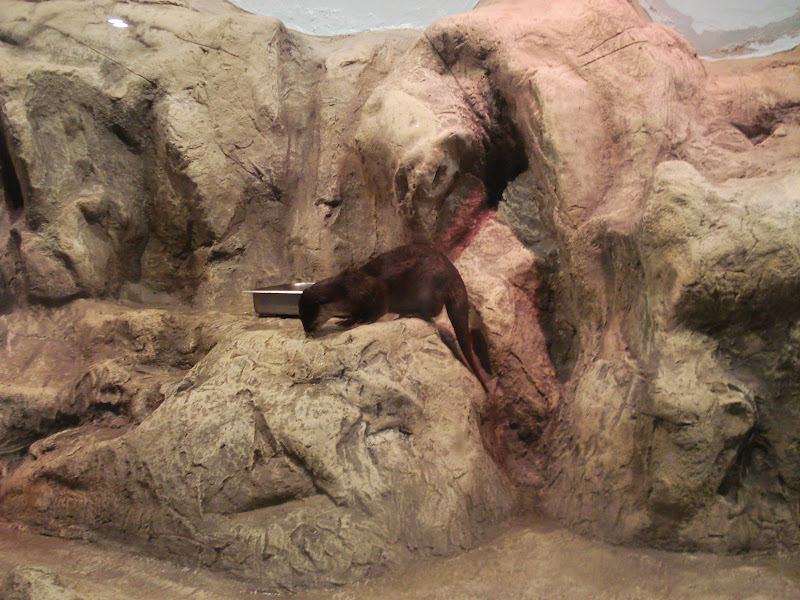
An Asian river otter. 
The piranha tank. This caused a great deal of confusion as my students refused to believe, when I told them in both English and Korean, that these tiny fish ate people. The English sign reading "Man-eating piranha" which my students read as though there was no hyphen was of no help. The reaction when I finally dragged them over to the Korean sign was doubly hilarious because of this :D.

A giant clam.
The orange dot you see peaking out of the clam is actually a small fish that seemed perfectly content to be in there whether the clam was closed or open.

Jelly fish!
A view of the 360 Aquadome from outside.
Inside the dome.


Oyster Farms
While the rain, sadly, kept me from staying for the evening's free K-Pop concert (I decided instead to catch the bus home with my school - shame, it would have been nothing short of awesome to have seen 2PM and miss A live), the sky did clear around midday, allowing us to catch the Korean culture and talent show occurring out near the 'Big O'.


Yes, those are real live girls swaying on bamboo poles!


All in all, it was a pretty great day. I definitely recommend going if you get the chance - although chances are limited since the expo period ends on August 12th (it's been on since May). Single day tickets are 33,000won, double days are 53,000. All concerts are free for ticket-holders and there are a number occurring on any given day. I recommend going on a weekday as weekends can get pretty busy and lines will be long. For more info on the expo, please click here. For a map & pavilion details, click here. For a listing of K-Pop concerts occurring on the ground, click here. Note that there is a free bus to the expo departing from and returning to Gwangju. I don't have any of the details. I do, however, know that seats must be booked 3 days in advance. 

Friday, July 6, 2012

Seoul Base Camp Hostel

While I'm sure you're all sick of Seoul-related posts, after nearly 7 weeks away, It was time for me to head back to the capital. What can I say, dance, friends and family exert a strong pull  ^_~.  Alongside my usual activities, I also had the opportunity to check out a fantastic new hostel.

Seoul Base Camp Hostel is located about 10 steps south of Exit 8 of Hapjeong Subway Station (합정역). Placing it at short 15minute walk from the heart of the vibrant Hongdae area.  Run by Min and Jake, this hostel has a great vibe and hosts who speak English. The space was formerly an old time-y dance hall (apparently they occasionally still get some of the older clientele dropping by looking for some swing dancing!) and I love what they've done with it. Rather than put up walls, they've used canvas to give the place a vast tent-like feel. Their wooden-cubby beds act like noise and light dampeners to ensure that you get a peaceful night's sleep. They also have normal bunks for those wishing for a wider, less enclosed sleeping space. More important to many visitors to Seoul, the Base Camp also offers a roof top terrace and (soon to be implemented) roof top bar offering one free beer per night to all guests, in addition to a (soon to be finished) hot tub. Follow up a great night with Min's delicious (and free) waffles in the morning for breakfast and you've got the perfect hostel! Check out the pictures below and be sure to look them up on Facebook, Google or their shiny new website at SeoulBaseCampHostel.com if you are interested in staying. The price is pretty low at present as they do not yet have the above mentioned features up and running, but that makes it even more worth the visit!


While the Base Camp experience was well worth the trip to Seoul in itself, what would a trip be without a little more exploration!

Although I've spent much of my Seoul-time in the Hongdae area, walking around with MinJung on this past trip, I spotted something I'd failed to notice before. The "Luxury" Norebang (singing room) chain has huge windows through which you can watch patrons as they belt their hearts out! I never would've noticed had it not been for the crowd of local Koreans snapping pictures. Couldn't get close enough to snap a clear shot, but check out this guy's moves below!


In addition to spending more time in Hongdae, I got to check out Dongdaemoon (동대문), or the "Great Eastern Gate" -  also called Heungjinmoon (흥진문), or "The Gate of Rising Benevolence".

The gate was initially built in by King Taejo of the Joseon (pronounced Chosun) Dynasty in 1398, was renovated in 1453, and then finally rebuilt in 1869 (presumably after it's destruction by the Japanese) and served as the Eastern passage through the city walls during the Joseon Period.


We also decided to explore the area to the west of Gyeongbuk Palace and to the East of Hongdae a bit more thoroughly as neither my friends nor I had ever been.


We discovered a few delights such as the statue above, the old streetcar below, and the Seoul Museum of History (which I sadly did not have time to explore).


There was also a lovely little covered excavation preserving storefront layout from the Joseon.


Also over this way is the much quieter and quainter Gyeonghuigung (경희궁), or Palace of Serene Harmony. A great place to go for a break from the busy-ness of Seoul, Gyeonghui was built to harmonize with the surrounding landscape, giving it a wonderfully peaceful air. This is also helped by the fact that it's the smaller sibling of the other 4 great Joseon palaces and, so, was nearly empty of tourists when we visited. Entry is also free.


Apparently hour-long Taekwondo demonstrations are regularly held on the grounds. Sadly, we didn't manage to catch these.

Next, it was time for me to dash down to the Sinsa (신사 - pronounced Shinsa) area to meet up with some family. While I don't have any pictures. The area is a lovely part of town, and well worth visiting. Its filled with quaint boutiques and larger unobtrusively placed chain stores. Perfect for shopping. It was here that I also finally managed to try Korea's summer specialty: Naengmyun (냉면) or, literally, cold noodles.

Yes, those are, in fact, ice cubes you see floating in my soup!

Friday, June 29, 2012

Namhae! Korea's Treasure Island.

A few weekends ago, I joined one of Pedro's trips down to the beautifully stunning island of Namhae (남해). Located about 2.5hours south of Gwangju, Namhae is known as Korea's treasure Island for it's unspoiled, still largely agricultural, beauty; with many terraces and rice paddy's built into the steep mountain sides that descend into gorgeously clear waters.

Our first glimpse of Namhae came as we exited the mountains on the mainland and emerged on the coast, only to see - No! It couldn't be! The Golden Gate Bridge? We couldn't possibly have driven that far!


Built in 1973, the bridge connects Namhae to the mainland.  This view is made even more stunning by the small islands dotting the seas surrounding the area. This view was our introduction to the island in more ways that one. Namhae is not yet sufficiently touristy (a great blessing!) to warrant a viewing platform at the bridge. Instead, we stopped at a small market outpost by the side of the road. It was here that we first came to realise that alongside rice, onions and garlic play a huge role in this region's economy (so much so that there are quite a few statues of garlic located on the island!).

Bundles of garlic and onions for sale and transport.
Although it is certainly not the biggest of Korea's islands, Namhae's jagged coastline and rugged mointains make for long (and stunning) journeys when trying to get around. On our way down to the southern-most tip of the island, we stopped for lunch at a house located in the German Village (built entirely in the German style and with German Materials by Koreans and Korean-Germans who went to Germany in the 1960s to find work and later returned). Worth the peak in, the house contained some of the oddest assortments of objects I've ever seen.


The Sunshine Curiousity Museum near the German Village
My favourite discovery of the stop, however, was a toad. No, really, a live toad. It was adorable and beautiful and... well, I'll just let you see the picture below :).

Isn't it just too cute?
Winding along the coast (breathtaking), we eventually made our way to the now-famous (after having it's beauty captured by a TV commercial) Dareangi Village where we stayed the night with a local 할머니 (halmoni, or Korean grandmother). Built into a steep ocean cliff-side on 108 terraced steps, Dareangi Village (다랭이마을) is made even more beautiful by the pastel coloured roof and stucco wall paintings that adorn all of the homes.

A view of the sea and terraces, many of which (unsurprisingly I suppose) contain rice paddies

A lovely painted roof - many of these bore pictures of fruits and flowers.

Some of the wall paintings serve to remind that, even this far south, memories of the Korean war are never far away.

Just in case you have to turn your back on the view behind you, here it is once again ;).

Although the island does support some beautiful sandy beaches (more on those later), the coastline around Dareangi is rather rugged and forbidding. Still, clear blue water calls out on a hot day and, so, we made our way down to a local stone (the locals claim 'pebble' but I've never before seen pebbles quite that large!) beach.


Supply stores line the coast in case of North Korean attack.
I think it needs to be stressed that this is no East Coast, Namhae is located at the very South of the peninsula and still, this seems to be a real worry.

Caution! Teddy bear soldiers guard the outhouse!


Another lookout.

The not-quite-pebbles.

A view of Dareangi from the hike back up to the village. 

The hike back down to the point just below the village where sits Gacheon Amsu, the town's guardian rock.


Gacheon Amsu Rock

And the bridge that leads to it.


After a night spent roasting marshmallows in a bonfire made at an abandoned school yard (in the pitch black), it was time to hit up a proper beach!

But not before we got some great kayaking in *insert huge grin*. One of my favourite sports, sea kayaking in Namhae is not to be missed. The craggy coastline makes for all sorts of amazing coves and rock passages, with loads of interesting sea life to check out. Also - waves ^_^. I got thoroughly toasted and salted in our 3+hrs out on the water but it was well worth it. Wish I had more pictures, but I was, unfortunately, not brave enough to risk my camera in the venture.


The inland view of Julio's Kayak (고병국 카약) in Dumo Village. For pricing, directions and a great time, look him up on Google or Facebook :). Great instructor and loads of fun. He also goes out in a motor boat for longer journeys to ensure safety and a rest for kayakers in distress.

The beautiful sand of Sanju (산주) Beach which receives over 1 million visitors per year. For a quieter, but just as lovely, time, check out  Songjeong (송정) 4km to the east. The perfect way to end the day *insert pleasantly relaxed sigh here*