Showing posts with label Tomb. Show all posts

Saturday, October 20, 2012

Bulguk Temple & Seokguram Grotto. Gyeongju Day 2

After spending the night at a Jjimjilbang on the shores of Bomun Lake in Gyeongju's resort area. It was time to head off to the ancient Buddhist Temple of Bulguksa and it's accompanying grotto.


The backside of Cheomseongdae Jjimjilbang. No soothing bathing pools here, but they did have these huge tumuli-like saunas. I don't think I've ever before been in anything quite so hot. I barely lasted 10 seconds - and I've been to the Sahara in August!
The view of Bomun Lake from the front. I swear Jjimjilbangs always have the best views! This one also had something I've never seen before - designated sleeping rooms! One for men, one for women and one mixed. Unfortunately, even women snore. Family run, this place also had delicious food.

Founded in 528 AD, Bulguksa (불국사) was built at the time when Buddhism was first adopted as the state religion of the Silla Dynasty. Like many other such temples, it was destroyed during the Japanese invasions of 1953, remaining in disrepair until the 1970s. It is now a UNESCO World Heritage Site.

One of the two Stone Pagodas from the unified Silla Period. This one is much more ornate than many from the period. A single stone line, the only one of four that remains, is perched at the top of the steps. 

A collection of shoes outside the lecture hall where monks come to learn everyday. 

A stone prayer among many.

The remains of a hall.

I just loved the colours of this!

A heavily worn lucky bronze pig. The boar is one of the animals believed by Korean tradition to represent  longevity.

A view of "Four Bridges". Two flights of steps leading from the earthly world to that of the Buddha. They are national treasures and, so, cannot be climbed.

An ancient flag post. Flags announcing festivals, events and  Temple news were hung vertically from a rod which would have connected the two stones at the top. (You can see the slot in the leftmost pillar.)

I always claim that I'm going to refrain from climbing mountains and yet somehow that never seems to come to pass. A pavilion at the Seokguram Grotto Parking Lot, most of the way up Mount Toham. Buses were available, but they only leave once an hour. As I'd just missed one, I opted to make the 30-45 minute, 3km hike instead :).

The view from the Pavillion

Patrons can pay 1000won to visit the pavilion and ring the bell for peace. It was an offer I obviously couldn't resist. Much more fun than actually ringing the bell however, was placing your hand on it and feeling the vibrations go through your whole body as someone else rang it.

Seokguram Grotto (석굴암) is a hermitage that is home to a giant stone Buddha and attendant guardians housed in a temple that is built into the mountain. Unfortunately, in order to protect the site, there are no photos allowed and a pane of glass (which can be difficult to see through due to reflections of light from outside) separates visitors from the statue. Still, it was worth seeing (I went through twice). And the location offered some stunning views of the East Sea.

Attempting to capture the roof and rocky mound of the grotto.

After enjoying the sights of and from the grotto, it was time for me to head back into town. Unfortunately, I found that I had, once again, just missed a bus. I figured I was left with two options: 1) hike back down, and 2) continue upwards for the 1.7km to the top. Naturally, I chose the latter.

The view from the top.
Once back in the city, I found I had about an hour to spare before my bus ride back to Gwangju. So naturally, I chose to spend it eating Gyeongju Bbang (경주빵 - literally, Gyeongju Bread), a type of barley based sweet bread filled with sweetened red bean paste - far more delicious than it sounds - and relaxing among the tumuli in the free Noseo-ri and Nodong-ri parks.

er... rather, on the tumuli...
(Archaeological Disclaimer: warning, this is most definitely NOT allowed.)

A mother and son. Seeing them up here is what prompted me to join. So glad I did.

A sad departure. The little boy didn't want to come down. I know exactly how he felt!

Tuesday, September 4, 2012

Wonsan & The North Korean Countryside

A view of the countryside.
I was fortunate enough to have time to visit, not only Pyongyang, Kaesong and the DMZ, but The eastern port city of Wonsan as well. Wonsan (원산), is the capital of North Korean portion of the beautifully mountainous Kangwon province (강원도). It has seen several centuries of history as a port city, though you wouldn't know this to look at it as it remained under siege for the entire duration of the Korean War (March 1951 to 1953) with nearly nothing remaining of it by the end. Wonsan is a popular destination for North Korean holiday-makers (Yes, they do go on holiday! Many take the train from major cities or simply wait along the roadside by their farms for suitable transportation to come along. Kim Jong-il also had a nearby villa.). Wonsan is famous in the DPRK for a number of reasons, not the least of which is it's presence next to the lovely Songdowon Beach (송도원) and it's proximity to supposedly stunning Ulim waterfalls (sadly, the road had been washed out by recent rains, so we didn't get the chance to go). Other nearby sites which are much more interesting for the few foreign tourists who visit than they are for DPRK citizens are the Songdowon International Children's camp, where youths from Russia and a variety of African countries still come to spend a few weeks in the summer getting to know their North Korean compatriots, and Chonsam (천삼) Co-operative farm, one of the only working farms which foreigners are currently able to visit.

My visit to Wonsan, combined with taking the train out through the northwestern town of Shinuiju provided me with ample opportunity to enjoy views of the countryside in the southern and western portions of the country. This opportunity was made even better when we encountered a blocked tunnel en route to Wonsan and had to wait nearly an hour alongside the locals while it was cleared by the army.


Waiting at the tunnel.

The farmers about their business.


Heading to work.

Working the fields.

Local transport.

Songdowon Beach & Dive Towers

DPRK Sail Boats.

Playing volleyball with the North Koreans, I didn't join in this game (I'm notoriously bad at Volley Ball). I did join an earlier game of soccer/football (no pictures for the obvious reason that I was otherwise occupied) with some electrical engineering students from Pyongyang - two of whom spoke wonderful English!

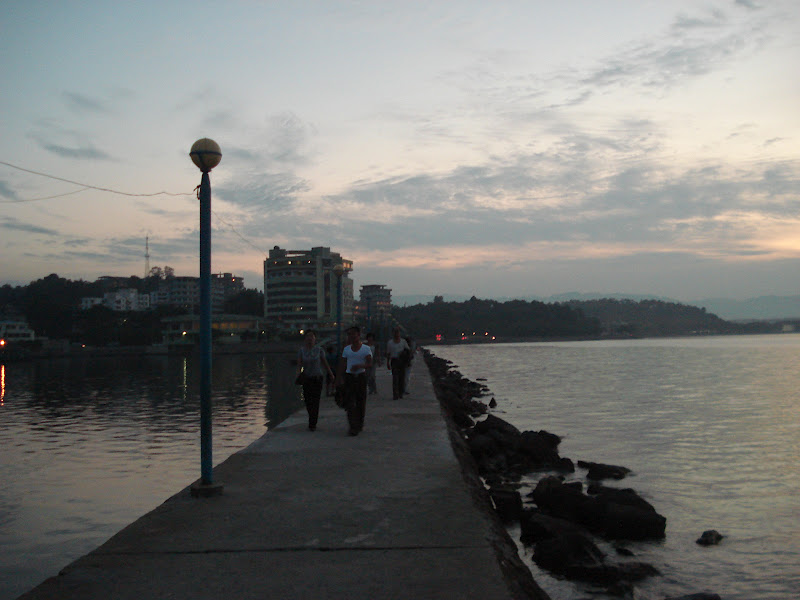
Heading out to the pier leading to the lighthouse on Jangdeokseom (장덕섬) Island at sunset.

Most rickety suspension bridge I've ever encountered. You could hear it creaking in the wind all night long.

A rusted old boat now used as a BBQ place and mini shellfish market by the locals.

A little further along the pier, women were clamoring for us to join them in their meals.


A lone fishing boat.

Looking back along the pier toward Wonsan.

Cheonsam Co-operative Farm. One of the features of the entire countryside is the uplifting inspirational music and discussion blaring through speakers placed in all of the fields. 

Their cultural hall/movie theatre with the mosaic of Kim Il-sung's visit and on the spot guidance to the left.

Rankings and Propaganda.


Movie Poster

A close up of the mosaic. The workmanship on these is incredible.

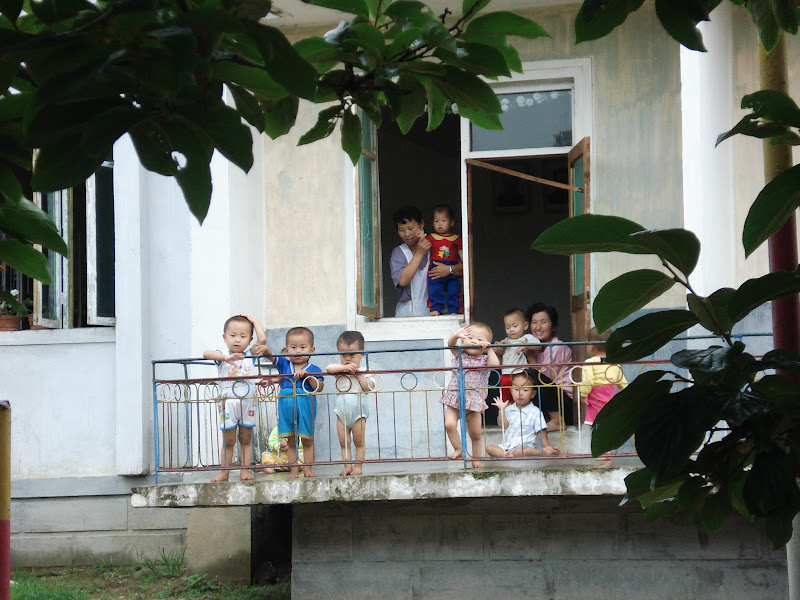
Kids at the farm's kindergarten.

They were adorable.

Farm work.


So cute! Also trained to repeatedly shout hello at foreigners when the visit. Kind of terrifying.

These two ran over when they saw us.

A kitchen in one of the nicer homes on the farm.

Fishing back at the pier.

These kids were adorable. They'd made their own can traps.

A view of Ot No (옷노 - Clothing Lake) at the Sinpyeong (신평) Hydroelectric Project Rest House..

The Rest House's obligatory portrait of the Dear Leaders.

A resort/sporting complex used by locals. Swimming and boating are regular activities here.

The tomb of King Dongmyong (동명). Dongmyeong was the founding monarch of the Goguryeo (고구려, pre-Goryo) Dynasty. He ruled while the capital was still located in China. He died in the 1st century BC. His tomb was moved to this location in 427 AD when the capital was transplanted here. The site has since been renovated.

A shrine commemorating the life, accomplishments and myths surrounding King Dongmyeong, also known by his birth name Go Ju-mong (고주몽).


Looking back toward the entryway.

The nearby Jeongreungsa (정릉사) Buddhist Temple, also rebuilt in 1993.

Buddhism is allowed to be practiced, as is Christianity, but conversion is a state crime and those who follow either religion are not allowed party membership.

One of the resident monks.

The countryside just south of Pyongyang.

Oxen are the main source of power on the farms.

The flatter countryside to the North and East of Pyongyang, visible on the train ride out.

A co-operative farm.