Showing posts with label Shrine. Show all posts

Monday, February 18, 2013

Jeju Island: Exploring a Gem of the Pacific

Last week, two friends and I decided to take advantage of our final long weekend in the country during Seollal (설날) - also known as the Lunar New Year - and hop on a ferry to what is reputed to be the most beautiful place in all of Korea - Jeju-do!

Recreations of the famous Jeju hareubang statues.
For those who don't know, Jeju (제주) is a small (73km by 41km) oval-shaped volcanic island 130km off the southwest tip of the Korean peninsula. Famed for it's beauty and often called 'the Hawaii of Korea', Jeju was recently named one of the New 7 Wonders of the Natural World - and I have to say, even in winter, Jeju lives up to it's hype.

Exploring the rock formations on the southern coast of Jeju.
While the 2 million year old island is literally littered with mini extinct volcanoes (360 of them to be exact), volcanic craters and lava tubes surrounding the main volcano of Hallasan (한라산) - also Korea's tallest mountain, coming in at 1950m (more on that in the next post!) - these are only part of what make the island so spectacular.

In addition to having a unique geology, Jeju's relative isolation has given it a unique cultural history. While Jeju was eventually annexed by the mainland Goryeo Dynasty in 1105 and the Mongols after that, then returned to Korea with the takeover by the Joseon Dynasty (who used it as a place to send political exiles) in 1404, and thus has shared much of it's more recent history (such as Japanese occupation) with the mainland, prior to this, Jeju-nese history is somewhat of a mystery.

Cheonjiyeon Falls (천지연 폭포) from a distance. You can see Hallasan rising into the clouds on the right.
Very little is known about the pre-Goryeo Tamma Kingdom and how it came to be. Island legend states that the three demigods: Go, Bu and Yang, rose out of the ground and became the islands first residents. When the three men were out hunting one day, they ran across three princesses who had washed ashore with all of their agricultural accoutrements and livestock. Marrying these three women, the hunters settled down and established the three main agricultural clans of Jeju island. The hole in the ground from which the hunters emerged can still be visited at Samsunghyeol Shrine (삼성혈)- which remains an important location for the seasonal ancestral rites performed by their descendants - in Jeju City.

A stone ring and tripple alter surround the hole through which Go, Bu and Yang entered Jeju at Samsunghyeol.
Other unique features of Jeju-nese culture include thatched roof houses - although these can only be seen today in the preserved traditional 'folk villages', the inexplicable ancient basalt mushroom-like grandfather statues called Dol Hareubang (돌 하르방) which dot the island, the hand-stacked stone dividing walls to allow for Jeju's famous winds to pass through without toppling them and, last but certainly not least, the haenyeo (해녀) - Jeju's famous women divers. Although now somewhat of a dying breed, women began to do the work of diving into the waters along the coast to collect shellfish in the 19th centuries when their husbands discovered that their families would be tax exempt if they did so!

As interested as I am in culture, as much as I loved hiking Hallasan and as fascinating as the publicly accessible portion of the lava tubes at the UNESCO World Heritage Site of Manjanggul (만장굴), geologically speaking, it was the coastline that took my breath away!

Looking toward Munseom (island) from some of the Rock formations along the coast in Seogwipo.
While the northern coastline around Jeju City (제주시) has some fun rocks, it's the south near Seogwipo (서귀포) that is really stunning. Not only is the area around Seogwipo studded with waterfalls, to the West of the city lies the resort area of Jungmun (중문), home to Korea's Jusangjeolli (주상절리) or  'Black Beach', made of hexagonal basalt formations reminiscent a smaller version of the Giant's Causeway connecting Scotland and North Ireland. While Jeju's Jusangjeolli is not as large as the Giant's Causeway, the emerald blue (no, really, that's the only way to describe the colour!) water the rocks rise out of makes it breathtaking to visit.

Jusangjeolli. The colour of the water made me nearly desperate to jump in - and it was February!

Jungmun is also home to Yakcheon Temple. While I have seen a lot of temples during my time in Korea, Yakcheonsa is ranks up there with my favourites. Done up in a more ornate style that reminds me more of the temples I've seen in Taiwan than any I've seen in Korea, the combinations of pastels and golds, as well as the amazingly detailed latticework carvings on the windows made a visit well worthwhile.

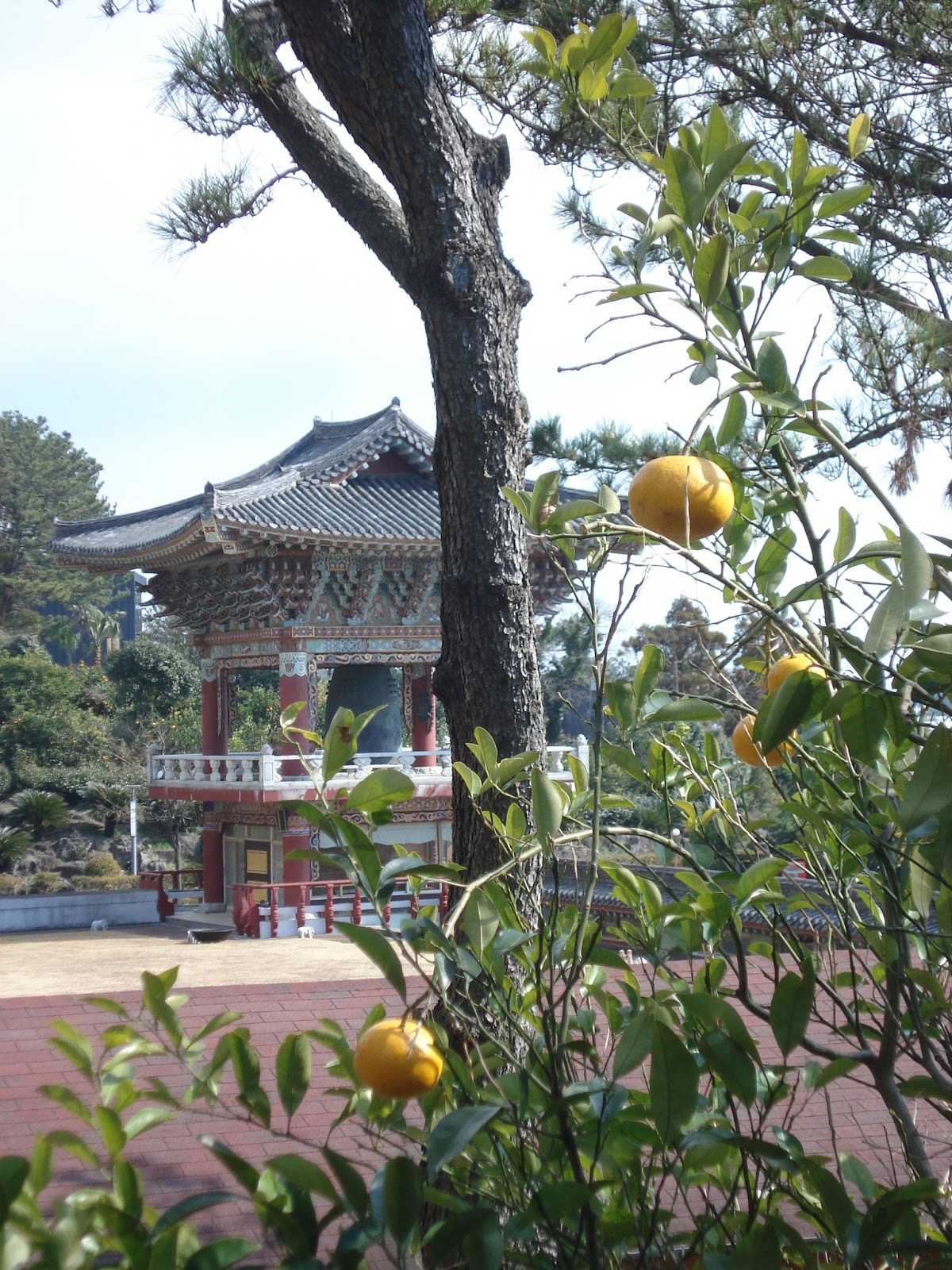
The bell tower at Yakcheonsa with oranges in the foreground. In addition to being famed for it's beauty, Jeju is famed for the deliciousness of it's oranges. Sadly, I was there a month too early for these ones to be ripe.

The giant gold Buddha inside Yakcheonsa. The great hall is said to be one of the biggest in Asia. With three floors of viewing galleries, each surrounded with painted panels depicting stories, I may well believe that.
Even further to the west along the southern coast was quite possibly my favourite spot on the island - the Yongmeori (용머리 - dragon's head) Peninsula. While it's invisible until you are down there and closed off at high tide, the coast below Sanbang peak (삼방산) if formed of weathered vocanic cliffs and caves that just bed to be explored. This is also where the monument to Handrick Hamel - the Dutchman who washed ashore on Jeju in 1653, was captured and enslaved, eventually managed to escape with 7 others in 1666, and wrote a book bringing news of life in the Joseon-era Hermit Kingdom of Korea to the rest of the world - and recreation of his ship are located. The small Mt. Sanbang itself is also worth a visit as it is home to Sambanggulsa (삼방굴사) or Sambang Cave Temple.

Looking toward the Yongmeori Coast from Sambang Temple. Hamel's ship is just visible in between the temple and coast.
A view of Hamel's ship through his momument.

While Jeju is fairly small, the sheer number of protruding mini volcanoes can make getting around the island somewhat time consuming. It's possible to travel by public transport, but having a car (and in smaller areas, bikes) might be more convenient (you need an international drivers licence though). We were lucky enough to stay in a wonderfully accomodating hostel (the owner even fed us traditional New Year's Tteok-guk (rice cake soup) on Seollal!), which offered cheap tailor-made driving tours. You can check out B&B Pan here. The island is also crisscrossed by 'Olleh Trails', 200km of connecting walking trails which have been divided into 13 different routes - although on many you can jump it at any point along the path.

Looking back toward Sanbang while walking the coast.

Some of the formations on the Yongmeori coast. This one is about three times my height.

Some more of the crazy geological features.
There are a number of ways to get to Jeju. Flights leave from most of the larger city airports on a daily basis and ferries, from Incheon (Seoul, 14hrs), Mokpo (4hrs) and Wando (3hrs), to Jeju City on the North Coast leave just as frequently. The fastest Ferry, and the most convenient for us, is the JH Ferry run by Orange1 which leaves from Jangheung (장흥), near Yeosu in southern Jeollanamdo, and arrives at Seongsan (성산) on the west coast of the Island in 2 and a half hours. There is also a free shuttle bus run by the ferry company which connects Gwangju to Jangheung. Their website is here. Unfortunately, it is entirely in Korean.

A view of Ilchulbong (일출봉), or Sunrise Peak in Seongsan on the East Coast at Sunset.

Wednesday, February 6, 2013

Tottori - Friends, Crab & Sand Dunes

Alongside satisfying my general travel bug, one of my objectives in visiting Japan was to take advantage of my time in Asia to meet up with those of my friends who live there and who I otherwise don't get many chances to see. Combine that thought with my love of anything unusual or off the beaten track and you can imagine my delight at discovering that, not only was one of my high school friends living in Tottori, a city in Japan's least populated area, but that he practically had sand dunes in his backyard - sand dunes! In Japan!

2km wide in places and extending for 10km along the coast, I was so excited about the prospect of seeing sand dunes in snow that I was nearly devastated when I heard it had all melted the week before I arrived - Thankfully, someone was listened and we got a whole bunch of snow the night I arrived.

Located on the northern coast of the Chugoku region of Japan, Tottori's quietness - especially in comparison to many of my other destinations on the trip - provided the perfect opportunity to sit back, relax, make some awesome new friends, absorb the scenery and enjoy vicariously soaking up some of what living in Japan has to offer.


Wandering the edges of a 'lake' formed by the melting snow at the base of the dunes. An established park with rangers who seem to exist to capture you on film (or SD card), they even have a live camel to act as a photo prop during the summers.

One of the problems with visiting a beach town in winter is that you see the surf and realise how awesome it must be to visit in summer. That said, there is also something charming about boats pulled up on shore in the snow.
If I was excited about the dunes, it was nearly nothing when compared to how I felt upon discovering that Tottori also had a crab museum - A Crab Museum! I realize that this might not seem all that exciting - even to fellow crab lovers such as myself, after all, museums are for seeing, not eating - but after spending 3 years walking past the Japanese spider crab shell in the Natural History Museum in Oxford on a daily basis, I was more than ready to see what a real live one looked like. They're huge!


Face off!  Weighing up to 18 or 19 Kg (that's 40 pounds for are you Americans) and with an arm span of nearly 4 meters (12 feet). These guys aren't huge, they're massive! They also apparently like to play rough. I'm told there used to be two in there. Now there is only 1. Less than one if you consider that 3 of his legs are gone. (My bet is that someone with keys just couldn't resist - I mean, could you imagine looking at that delectable-ness all day and not taking some home to fry up with butter for a snack?)

 I also loved visiting some of the more rural temples and shrines and, of course, enjoying that most Japanese of experiences, Onsen. For those who don't know, onsen are gender segregated public baths much like the Korean jjimjilbang (with the exception of the fact that jjimjilbang can also be slept in and are used more as social clubs than purely as bath houses). As Japan has much more volcanic action than does Korea (which has little to none on the mainland), many traditional Japanese onsen are served by naturally heated springs. They also tend to have outdoor pools - pure bliss on a cold, wet, snowy winter's day.  A trip to the onsen is made even more enjoyable by the fact that Japanese houses are traditionally only warmed by space heaters, with all hallways and other such adjoining passages (such as those connecting the bathroom to the general living/sleeping room) left unheated. While I might complain about this being the case with schools in Korea, at least most houses here (though not bathrooms) are heated fully by the underfloor ondol systems.

Ube Shrine. This is an Ise Shrine dedicated to Amaterasu, Goddess of the Sun, ancestress of the imperial line and greatest of all Kami (Shinto spirit-gods) - although the latter part of this designation only came to be emphasized during the Meiji Restoration of the19th century in order to strengthen the legitimacy of rule of Japan by the Emperor (and not the shogunate).
Alongside getting in a soak at the onsen, I was also given the opportunity to practice that other traditional Japanese activity - purikura! The first love of teenage girls all throughout Japan (and much of Asia), purikura are photo-stickers made by posing ridiculously in photo booths with friends and then digitally drawing all over the resulting images before printing them off. It's disturbingly enjoyable, particularly as the digitization process wipes away any facial flaws or impurities, making make-up completely unnecessary for glamour.

Purikura! Also, far too much fun when one has a train to catch.

Monday, February 4, 2013

Of Shrines & Hikes, A Visit to Miyajima

Just a thirty minute local train ride and 10 minute ferry southwest of Hiroshima lies the adorably stunning island of Miyajima. Famous for the floating torii of Itsukushima-jinja and delicious oysters (they were so good!), Miyajima is well worth the trip*.

The 'floating' torii of Itsukushima Shrine as seen from the ferry.

Although I certainly appreciated the view of the torii (although I'm sure my poor camera could have stood to be pointed at something else by the end of the day), my favourite part of the Miyajima was the oportunity to hike! While many choose to take the cable car most of the way up Mt Misen to check out the sites, quite by accident I found myself wandering up the longest route on the backside of the mountain in the company of a troup of Japanese police offices - one of whom was lugging his mountain bike up the mountain purely so that he could ride it down.

My hiking buddies! They ranged in age from 30 to 61 - a fact the eldest did not let the 57 yr-old forget when he fell a touch behind!
It was lovely. The island was so green that if it hadn't been for the flurries occaisionally falling down, I might have thought that it was summer! Or, at the very least, that it wasn't the middle of January!


The early morning sun breaking through the clouds on the back side of the mountain.

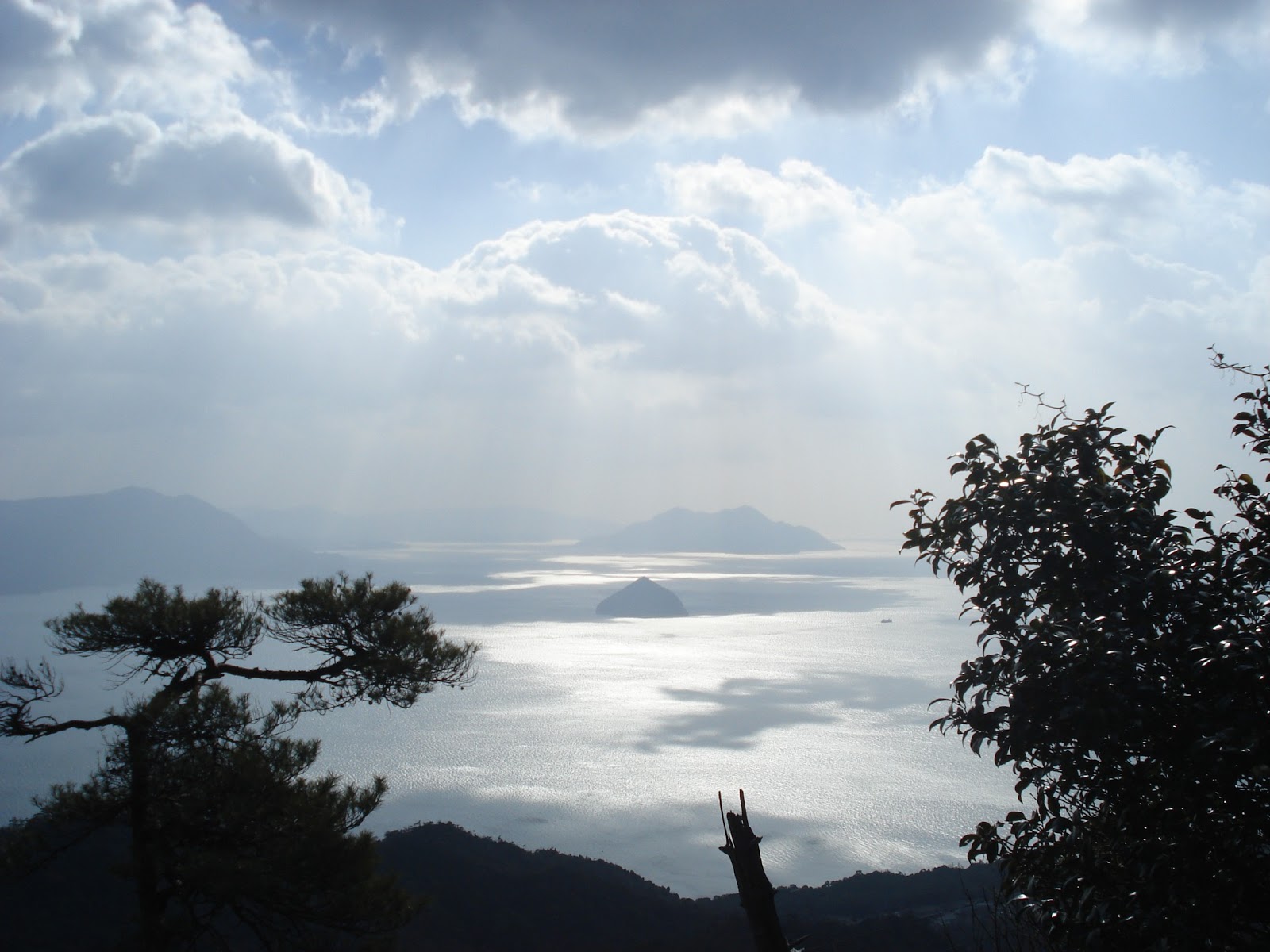
Looking back toward the coastline from near the top. Hiroshima is on the far right hand side.

In addition to Itsukushima-jinja with it's floating noh (Japanese drama) stage and torii, Miyajima is home to a number of other important sites such as the 13th century Buddhist temple of Daigan-ji and 8th century Daisho-in, the 16th century Senjo-kaku pavilion and the temple at the summit of Mt. Misen where Daisho (Namesake of Daisho-in) is said to have meditated for 100 days after visiting China, lighting a flame that is still burning today (literally).


A monk tends Daisho's still burning flame near the top of Mt. Misen.


Much like in Nara, the deer in Miyajima go wherever they please. This one is on the top of the mountain.


Descending back into town via the Daisho-in route. Although you can see that the tide is going out. It still looks somewhat as though the torii is floating.

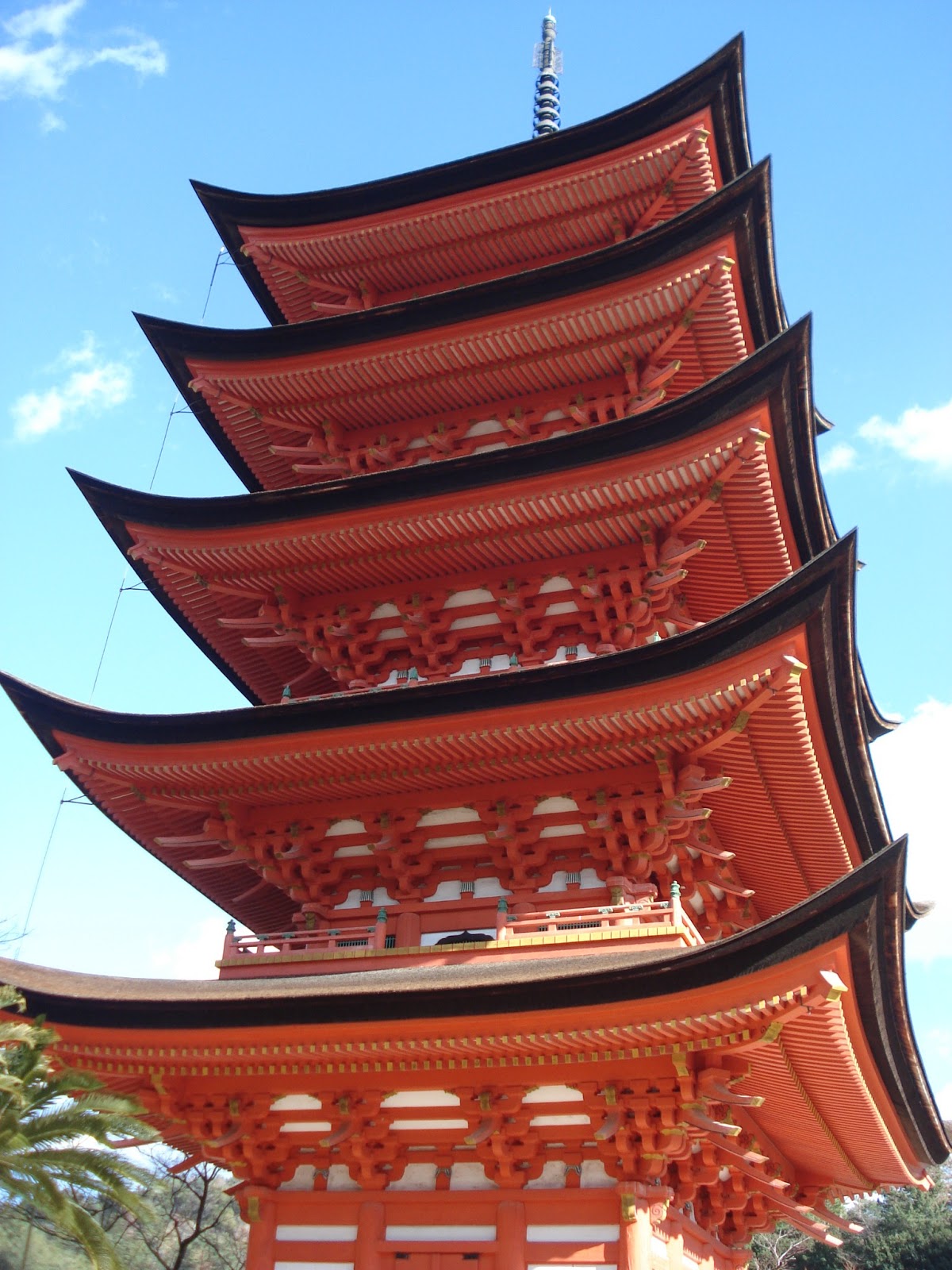
A 15th century Pagoda located next to Itsukushima-jinja.

Looking out toward the torii from inside the halls of Itsukushima-jinja. During high tide all of this is covered by water and the shrine too looks like it's floating.

A view of both the noh stage and torii from the main hall of the shrine.

Walking out to touch it. Many people leave coins resting up against the barnacles that line the bottoms of the pilars for luck.

*For those looking for cheap yet awesome accomodation in the Hiroshima area, check out Backpackers Miyajima. It's located just down the road from the ferry docks, train and subway station on the mainland and the staff are absolutely awesome.

Look at all the Deer! Day-Tripping to Nara

Located between 30 and 45 minutes (depending on the speed of your train) from both Kyoto and Osaka, Nara is the perfect day trip location when it comes to providing a break from the pace of either city life in latter or the back-to-back, never-ceasing cultural sites that fill the former.

Standing outside of the Daibutsu-den Hall of Todai-ji.

Although filled with cultural sites of it's own - it was, after all, once the capital of Japan (prior to its movement to Kyoto later in the 8th century) - Nara's relatively small size and the fact that most of its sites are arrayed around Nara-koen, Nara's deer-filled park, make it seem much more manageable and much less overwhelming than Kyoto. 

To say that the deer are absolutely everywhere in Nara is simply the truth. To say that they go wherever they want is an understatement. To say that they are completely unafraid of humans is an even bigger one. I saw more than a few coats, bags and even backsides being lipped in the search for food. Here the deer are winding there way through some of the many hundreds of lanterns than line the way up to the Shinto shrine of Kasuga Taisha.
My favourite of the sites (and the only one pictured here) was, hands down, the Buddhist Temple of Todai-ji (500yen, 8am-4:30). Home to the famous Daibutsu, or Great Buddha, the temple was somehow simultaneously light, airy and awe-inspiring - bringing together all of the things that I imagine one should feel in the presence of those who have attained nirvana. It is, quite possibly, my favourite Buddhist temple - of a certainty, it's my favourite in Japan.

The Todai-ji Daibutsu, or Great Buddha. While this photo might not show it, the Daibutsu is one of the largest bronze statues in the world. Although this one was recast at some point during the Edo Period (17th- near 20th centuries), the original casting was done in 746.
 Guarded on either side by absolutely fierce-looking guardians, the hall housing the Daibutsu is nothing short of massive. Labelled as the largest wooden building in the world, it is actually a 1709 replica of the original - an original that was a third larger than the one in place now!

The Daibutsu-den Hall, aka, the largest wooden structure in the world.

To give some idea of its size, the statue above is 16 meters tall, and weighs in at around 437 tonnes of bronze and 130kg of gold. For a more personal demonstration of exactly what this means size-wise, please scroll down.

Forcing my way through a hole equivalent in size to the Daibutsu's nostril. Surprisingly, it wasn't that tight a fit!