Showing posts with label Japan. Show all posts

Friday, February 15, 2013

A Gala of Powder: Skiing Gala Yuzawa, Japan

Although I did not, unfortunately, have time to make it up to Hokkaido to ski the famed Niseko, I was still determined to get in on some of the much discussed Japanese powder :D. With my limited time, it seemed like my best option was to hop on the 75minute train from Tokyo's Ueno Station direct to the base of the Gondola at Gala Yuzawa for a day. Best choice ever. Lying within such easy access to Tokyo, Gala can often be crowded on weekends. Somehow, however, I managed to luck out and head over on a Sunday when the hill was relatively empty - something which may have had something to do with the nearly complete white-out conditions I found myself skiing in all day. While some people may enjoy seeing where they are skiing, there are also a number of benefits to white-outs - chief one of course, being the access to all that fresh powder!


Grabbing a photo from lower down on the mountain. This was the clearest it got all day.
Although the train ride from Tokyo to Gala Yuzawa isn't overly long, Gala is actually located on the other side of Honshu (the main Island), in Niigata Prefecture to the north of the Japanese Alps. It was really cool to see the day go from bright and sunny with no snow anywhere in Tokyo, to overcast with piles of snow up to my waist as we got further and further into the mountains. 


Coming down out of the fob bank as I head down toward the base of the gondola. 
Gala Yuzawa is not a particularly huge resort, with most of it's runs located on the top of the mountain, above the gondola. It also does not have particularly long or challenging runs - although there are quite a few fun black runs in the northern area and the 2.5km intermediate run to the base of the gondola makes for a nice ride (I imagine it's even nicer when you can see the view). What Gala does have - and in great quatities even when it's not a particularly snowy day - is exquisite powder. Living in Toronto, I'd forgotten how nice it was to ski on proper snow! While it may not be the best skiing on offer in Japan, it is definitely worth checking out if you have a free day - particularly if you have a JR Pass, in which case, the train ride is free.

Not-quite snow ghosts at the bottom of the mountain.

Overall, gear rental (clothes, accessories & skis/board) plus lift tickets runs for around $120 US per day (which is more than reasonable!), afternoon only (12-5) is just under a hundred. Sadly, Gala does not have any night skiing, but many of the resorts in the area do. For more info on Gala Yuzawa, click here.

Food & Drink in Japan!

Sorry for the brief hiatus there, these past two weeks of packing have been a little bit hectic. Today however, I am free to return to my pictures from Japan and discuss one of my favourite topics - FOOD!

A bowl of typical Japanese Miso Ramen, with the traditional broth, thin soba (thin buckwheat) noodles, flavouring vegetables and two slices of pork on top. Completely diferent from Korean ramyeon, but oh so delicious! Soba noodles can also be fried or served as ramen in oil broth, but miso was by far my favourite.
As I may have mentioned (raved about) in my post on Osaka, Japan - and particularly the Kansai region of Japan - does nothing if it does not do food well. In contrast to the typically chili-laden, heavily spiced Korean food I've grown used to, Japanese food is much (much) milder, with much of it not being spicy at all.   Japanese dishes are typically also saltier than their Korean counterparts, with more miso-y, soy flavours.

A variation on the traditional Japanese Shabu-Shabu (hotpot). This one contains thinly sliced pork, tofu, mushrooms, cabbage and udon (thick buckwheat) noodles cooked in soy milk. Although I was initially skeptical, it turned out to be mouthwateringly yummy :).  
Street food, such as takoyaki (battered and fried octopus balls) which mentioned in my post on Osaka, also plays and extremely important role in Japanese eating culture. A more substantial meal-sized version of takoyaki also exits. Okonomiyaki, which literally means 'whatever you want grilled' is a large savoury pancake made by mixing together - well, whatever ingredients you want - and frying them up in batter. This can be done either by your server or, by yourself at a hotplate table in certain restaurants. It is quite delicious and is a Kansai specialty, although Hiroshima is also known for having its own version in which the pancake, egg and other ingredients are not mixed prior to frying and are then served on top of a plate of noodles. I found that I much preferred the Kansai variation, though I have a number of friends who disagreed.

Okonomiyaki ingredients prior to mixing, the white buble-like things in the top left corner of the bowl (can bowls have corners?) are actually bits of tempura.
The result post-fry up, complete with okonomiyaki sauce (think sweetened Worcester sauce) , seaweed  flakes and dried fish flakes (usually bonito) on top. In the corner. Japanese mayonnaise is also a classic topping, although the portrait being drawn by one of my friends at the table is a little more atypical.
Of course, in the eyes of most people, one has not truly discussed Japanese food unless one has mentioned one of two things - Sushi, or Green Tea. I am happy to report that I consumed both while on my trip, and that both are indeed delicious when consumed in their native land.

Mini-squid sushi at a conveyor belt sushi place in Kyoto. Between my friend and I, many many plates of sushi were consumed. This was the final plate and it rocked! More 'normal' varieties were also offered.
While in Tokyo, I was lucky enough to have my lovely friend Ayumi take me out and insist that I try some traditional Japanese green matcha tea. We also had tasty brown rice tea, but it is the matcha that truly sticks. Matcha is thicker and frothier than typical green tea and is made directly from boiled finely powdered leaves (as opposed to steeping them). It has a surprisingly deep, rich, unsweetened taste which made me question why it is not always consumed in this way!

A bowl of matcha served with lightly flavoured agar (gelatin)-based desserts in a sweet syrup with soybean powder. Definitely a must have. 
In addition to providing great food, Japanese restaurants (particularly in Tokyo) can often be done up with quite quirky and fun themes. Here I am sharing a meal with friends in what is essentially an over-sized Christmas ornament!

Thanks guys! You rock :)!

Wednesday, February 6, 2013

Tottori - Friends, Crab & Sand Dunes

Alongside satisfying my general travel bug, one of my objectives in visiting Japan was to take advantage of my time in Asia to meet up with those of my friends who live there and who I otherwise don't get many chances to see. Combine that thought with my love of anything unusual or off the beaten track and you can imagine my delight at discovering that, not only was one of my high school friends living in Tottori, a city in Japan's least populated area, but that he practically had sand dunes in his backyard - sand dunes! In Japan!

2km wide in places and extending for 10km along the coast, I was so excited about the prospect of seeing sand dunes in snow that I was nearly devastated when I heard it had all melted the week before I arrived - Thankfully, someone was listened and we got a whole bunch of snow the night I arrived.

Located on the northern coast of the Chugoku region of Japan, Tottori's quietness - especially in comparison to many of my other destinations on the trip - provided the perfect opportunity to sit back, relax, make some awesome new friends, absorb the scenery and enjoy vicariously soaking up some of what living in Japan has to offer.


Wandering the edges of a 'lake' formed by the melting snow at the base of the dunes. An established park with rangers who seem to exist to capture you on film (or SD card), they even have a live camel to act as a photo prop during the summers.

One of the problems with visiting a beach town in winter is that you see the surf and realise how awesome it must be to visit in summer. That said, there is also something charming about boats pulled up on shore in the snow.
If I was excited about the dunes, it was nearly nothing when compared to how I felt upon discovering that Tottori also had a crab museum - A Crab Museum! I realize that this might not seem all that exciting - even to fellow crab lovers such as myself, after all, museums are for seeing, not eating - but after spending 3 years walking past the Japanese spider crab shell in the Natural History Museum in Oxford on a daily basis, I was more than ready to see what a real live one looked like. They're huge!


Face off!  Weighing up to 18 or 19 Kg (that's 40 pounds for are you Americans) and with an arm span of nearly 4 meters (12 feet). These guys aren't huge, they're massive! They also apparently like to play rough. I'm told there used to be two in there. Now there is only 1. Less than one if you consider that 3 of his legs are gone. (My bet is that someone with keys just couldn't resist - I mean, could you imagine looking at that delectable-ness all day and not taking some home to fry up with butter for a snack?)

 I also loved visiting some of the more rural temples and shrines and, of course, enjoying that most Japanese of experiences, Onsen. For those who don't know, onsen are gender segregated public baths much like the Korean jjimjilbang (with the exception of the fact that jjimjilbang can also be slept in and are used more as social clubs than purely as bath houses). As Japan has much more volcanic action than does Korea (which has little to none on the mainland), many traditional Japanese onsen are served by naturally heated springs. They also tend to have outdoor pools - pure bliss on a cold, wet, snowy winter's day.  A trip to the onsen is made even more enjoyable by the fact that Japanese houses are traditionally only warmed by space heaters, with all hallways and other such adjoining passages (such as those connecting the bathroom to the general living/sleeping room) left unheated. While I might complain about this being the case with schools in Korea, at least most houses here (though not bathrooms) are heated fully by the underfloor ondol systems.

Ube Shrine. This is an Ise Shrine dedicated to Amaterasu, Goddess of the Sun, ancestress of the imperial line and greatest of all Kami (Shinto spirit-gods) - although the latter part of this designation only came to be emphasized during the Meiji Restoration of the19th century in order to strengthen the legitimacy of rule of Japan by the Emperor (and not the shogunate).
Alongside getting in a soak at the onsen, I was also given the opportunity to practice that other traditional Japanese activity - purikura! The first love of teenage girls all throughout Japan (and much of Asia), purikura are photo-stickers made by posing ridiculously in photo booths with friends and then digitally drawing all over the resulting images before printing them off. It's disturbingly enjoyable, particularly as the digitization process wipes away any facial flaws or impurities, making make-up completely unnecessary for glamour.

Purikura! Also, far too much fun when one has a train to catch.

Feeling the Vibe in Osaka

Although this might come as a surprise to those who know me, the glitzy, fashion conscious, shiny new building- and shopping arcade-filled urban knot that is Osaka actually turned out to be my favourite stop of the trip - a stop which I sincerely wish could have lasted longer!

Osaka's Umeda Sky Building. Home to both an indoor and outdoor observation deck (the latter 173m above ground), my favourite aspect of visiting was taking the escalators which connect the two legs of the building and span a height of 5 stories. I may have enjoyed this too much as I made Osaka local Yugi ride up and down them with me several times.  


A young boy gazes in wonder at the Pikachu on the screen at Osaka's Pokemon Centre. The place to go to buy anything Poke-related, the Pokemon Centre is located on the 13th floor of the Diamaru Department Store, one of the many glitzy department stores surrounding Osaka Station.

In many ways, Osaka's cityscape can be said to be much like Tokyo's. Like Tokyo, Osaka is a coastal city that does not seem like one; and, like Tokyo, much, if not all, of the old city was destroyed during the last world war, making space for gleaming new high-rises and fancy shopping centres. Yet somehow, the two are not the same at all. Maybe it was all the neon, or maybe it was just in the more laid-back attitude that seemed to roll of those living there, but to me, Osaka just seemed to beat with this incredibly addicting pulse that Tokyo lacked. It was basically everything I expected a modern Japanese city to be - and more.

Some of the bright neon lights in Shin-Sekai, the area in which I stayed. Described as 'a world that time forgot, home to ancient pachinko parlours, rundown theaters, dirt-cheap restaurants and all manner of raffish and suspicious characters' by the Lonely Planet, I found that I loved this area just as much as I did the much newer and happening Shimbashi & Namba areas (the latter of which is pictured further down). In the centre of this photo is Osaka's Tsuten-kaku, originally built in 1912 and rebuilt in 1969 after the war, at only 103m high, it's actually much shorter than a number of the buildings around it. 

One of said gaming parlours. These establishments can be found in numbers on nearly every shopping street in Osaka, and they always seem to contain players of every conceivable age range.
The road leading to Osaka-jo. Although Osaka is home to a number of excellent museums, Osaka Castle is the only real 'historical site' in the city (disregarding the lovely ruins of an earlier fortification located to the northwest of it that all those not-archaeologically-minded are likely to ignore). A 1931 concrete reconstruction of Tokugawa Ieyasu's 17th century castle (which itself was a reconstruction of Toyotomi Hideyoshi's late 16th century 'impregnable' granite castle destroyed by the Tokugawa forces), Osaka-jo offers not only an excellent view of the city from the top floor, but a nice museum filled with artifacts and detailed explanations of who's who and what they did as it relates to the history of the castle and shogunate.

If Osaka is famous for one thing over anything else, it is food - and boy does Osaka do food! (And here is where all those who know me are nodding in sudden comprehension of my love for this city - okay, so I'll admit, the food may have had something to do with it, but it wasn't only the food, I swear!). Osaka also doesn't just do food, it does it in both quality and quantity - lots of quantity. With entire areas of the city seemingly dedicated to nothing else, I, who am rarely ever full, managed to happily achieve that distinction and more.

Trademark Osaka Takoyaki - battered octopus balls. I've loved these since I first tried them in Taiwan. Osaka is said to have the best. There is an entire restaurant-museum dedicated to these in the Odaiba area of Tokyo.

A Lively shopping district during the day, the Minami area, comprised of Shinshabashi and Namba seems to really come alive at night. In the Shimbashi area to the north of the Yodo River, small exclusive looking bars and clubs are the name of the day (er... night.), while to the south in Dotombori and Namba, it's food, food and more food. I was lucky enough to head out this way on my first night in search of a late dinner and, although it was a Monday, by 10 or 11pm both areas were full of life in the form of the young and eccentrically dressed - fashion in Osaka is taken seriously (I had and old man look at me disparagingly for having such insufficient fashion sense that I was wearing slightly flared jeans in this day and age) and the aim seems to be to look unique. I can't even begin to describe the results of this drive, but it was one of the things that I loved about the city.
 
One of the food filled streets in Osaka's Namba-Dotonbori District. I think this is how I imagine heaven.
While much of what I loved about Osaka was its loud unabashed liveliness, one of my favourite things about wandering around its side streets in search of some new delicacy was stumbling upon some of its quieter places. It was those places that really brought home that this was a city that was both loved by those here and well lived in.

Like many of the other small charming shrines and temples frequented by locals in Osaka, Hozen-ji was located down an alley-way off one of the shopping arcades (in this instance, off one of the arcades to the south of Dotombori). Unique from many of the other Buddhist temples I saw while in Japan, Hozen-ji is centred around a statue of Mizukake Fudo that has been completely covered in moss due to the practice of sprinkling it with water in order to ensure the granting of a wish.

Tuesday, February 5, 2013

Exploring Kansai: Himeji & Kobe

Given my proximity to them once I'd arrived in Osaka, I figured I'd take a day to visit two of the most
popular nearby sites - cities really - Himeji and Kobe.

Himeji-jo, or Himeji Castle, built by Toyotomi Hideyoshi in 1580, has long been famed as one of Japan's absolute best. Unfortunately for visitors, the main keep has also been under renovation and restoration since 2009, and will continue to be until 2014. Still, I decided to check it out and see what I could (which turned out to be the Western Bailey and nearby garden of Koko-en).

Samurai suits on display in Himeji-jo. You can try some (costume versions) on for pictures at the nearby Hyogo Prefecturial Museum of History or at Osaka-jo in Osaka.
More than just the castle, I found that I quite enjoyed my morning wandering Himeji city with its relaxed feel, mix of old houses and newer buildings, wide tree-lined streets and narrow shopping arcades. For me it just sort of epitomised a lot of what I loved about the whole Kansai region (which encompasses Kyoto, Osaka, Nara, Himeji, Kobe and many other well known locations - it's also the region most famous for its food). This all having been said, I wouldn't necessarily recommend Himeji as a must-see until after the restorative works have been completed.

Looking out from the open window to the courtyard from one of the rooms in the Western Bailey.

Having enjoyed my time wandering around Himeji, I decided to stop off in the seaside city of Kobe, located midway between there and Osaka, for the afternoon. While Kobe is famous in Japan for both its beef and cosmopolitan atmosphere (having played an important role in international trade throughout history), there was so much more than just those two things to love about it.

Almost like a mini laid-back seaside Osaka (given it's size and sprawl, its easy to forget that Osaka too is a port city), I thoroughly enjoyed my time wondering through the streets of Kobe and exploring its many nooks and crannies. And the food! There was so much of it! And it was so delicious! And cost so little!

Having heard mention of them before hand, I also decided to check out some of the many sake breweries that extend north from the harbour to the east of the city centre. Although confusing to find (I would have been lost had not a lovely dog-walker in the neighbourhood been willing to practice her English - in addition to being good cooks, people in Kansai were super friendly!), the breweries were quite fun to visit. Not only was there decent English language signage on many of the dioramas depicting traditional and modern sake-making techniques (and an explanatory English video to boot! Ask at the front desk for them to set it up), the free samples they gave out went down surprisingly smooth.

A diorama depicting 'kimoto zukuri', the traditional way of  making moto (sake rice mash), at the Kiku-Masamune Sake Brewery Museum. Now done using special steel mashing boots, the traditional kneading of koji (malted rice), steamed rice and well water to encourage the growth of lactic acid bacteria and yeasts for fermentation used to be done by men rhythmically pushing long wooden implements (resembling nothing more than wooden curling brooms) in time to chanting long into the night.
Some deliciously dry Kiku-Masamune Sake (left) and some equally delicious but somewhat biting chilled plum brandy (right).

Monday, February 4, 2013

Of Shrines & Hikes, A Visit to Miyajima

Just a thirty minute local train ride and 10 minute ferry southwest of Hiroshima lies the adorably stunning island of Miyajima. Famous for the floating torii of Itsukushima-jinja and delicious oysters (they were so good!), Miyajima is well worth the trip*.

The 'floating' torii of Itsukushima Shrine as seen from the ferry.

Although I certainly appreciated the view of the torii (although I'm sure my poor camera could have stood to be pointed at something else by the end of the day), my favourite part of the Miyajima was the oportunity to hike! While many choose to take the cable car most of the way up Mt Misen to check out the sites, quite by accident I found myself wandering up the longest route on the backside of the mountain in the company of a troup of Japanese police offices - one of whom was lugging his mountain bike up the mountain purely so that he could ride it down.

My hiking buddies! They ranged in age from 30 to 61 - a fact the eldest did not let the 57 yr-old forget when he fell a touch behind!
It was lovely. The island was so green that if it hadn't been for the flurries occaisionally falling down, I might have thought that it was summer! Or, at the very least, that it wasn't the middle of January!


The early morning sun breaking through the clouds on the back side of the mountain.

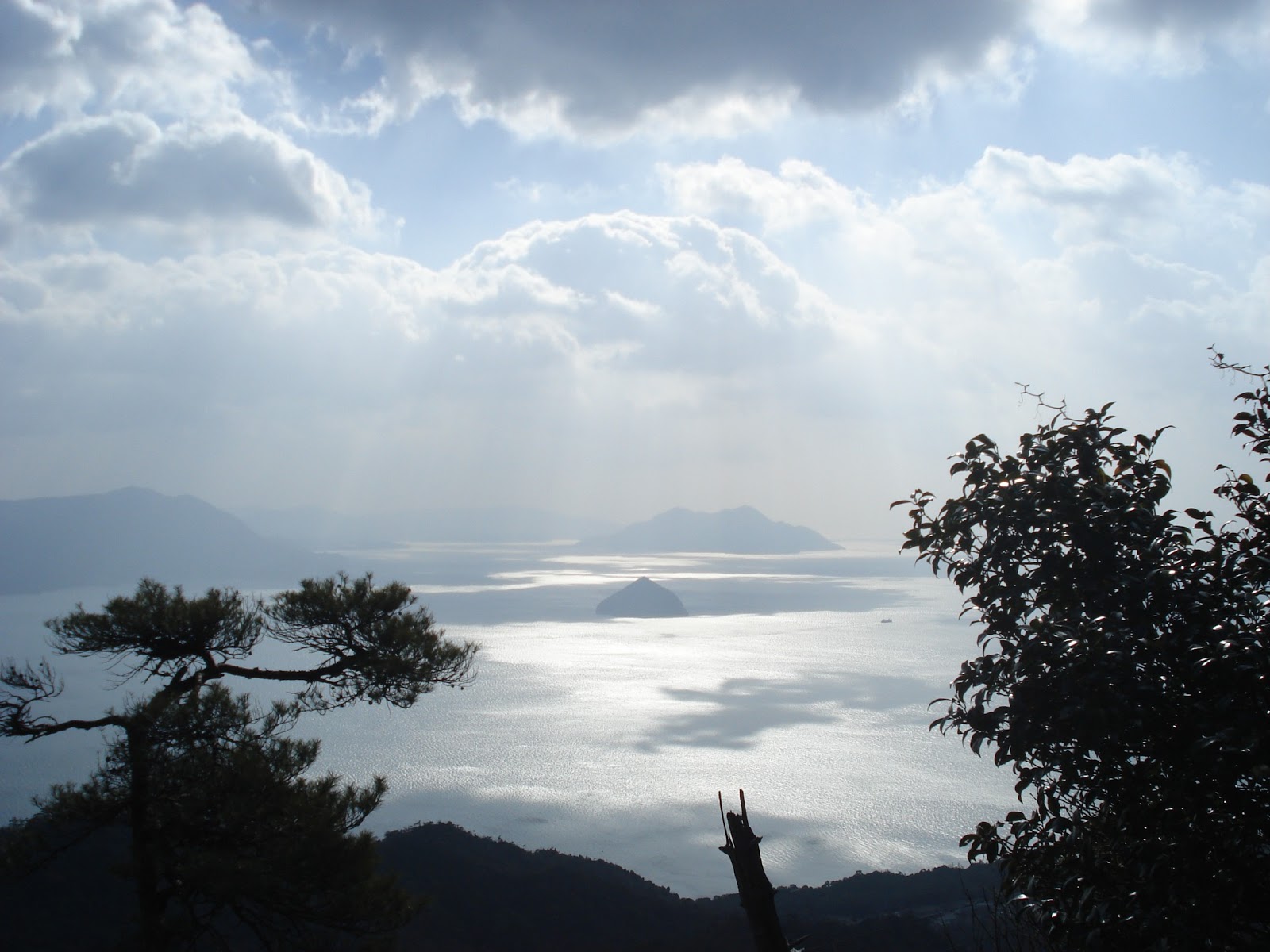
Looking back toward the coastline from near the top. Hiroshima is on the far right hand side.

In addition to Itsukushima-jinja with it's floating noh (Japanese drama) stage and torii, Miyajima is home to a number of other important sites such as the 13th century Buddhist temple of Daigan-ji and 8th century Daisho-in, the 16th century Senjo-kaku pavilion and the temple at the summit of Mt. Misen where Daisho (Namesake of Daisho-in) is said to have meditated for 100 days after visiting China, lighting a flame that is still burning today (literally).


A monk tends Daisho's still burning flame near the top of Mt. Misen.


Much like in Nara, the deer in Miyajima go wherever they please. This one is on the top of the mountain.


Descending back into town via the Daisho-in route. Although you can see that the tide is going out. It still looks somewhat as though the torii is floating.

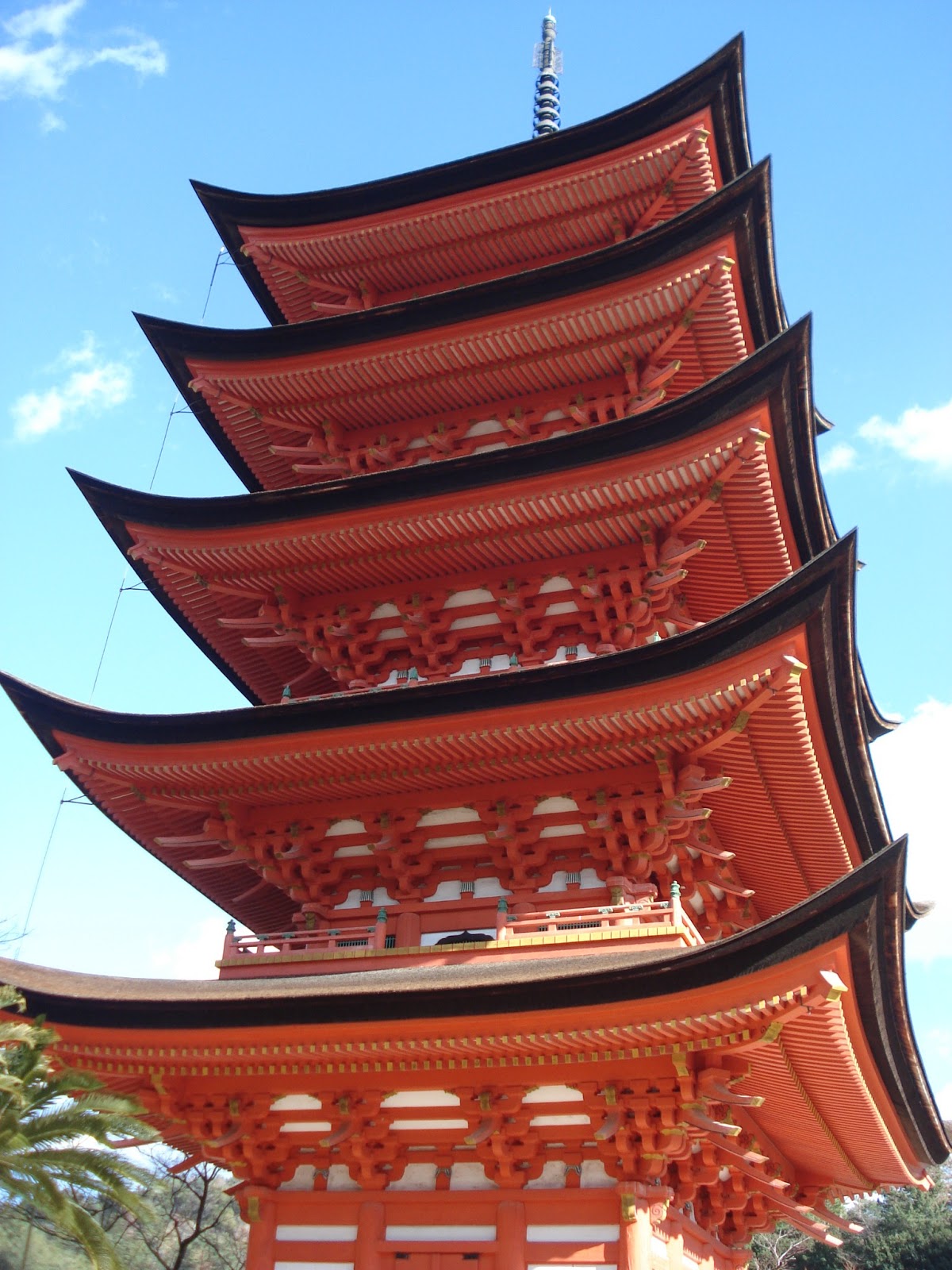
A 15th century Pagoda located next to Itsukushima-jinja.

Looking out toward the torii from inside the halls of Itsukushima-jinja. During high tide all of this is covered by water and the shrine too looks like it's floating.

A view of both the noh stage and torii from the main hall of the shrine.

Walking out to touch it. Many people leave coins resting up against the barnacles that line the bottoms of the pilars for luck.

*For those looking for cheap yet awesome accomodation in the Hiroshima area, check out Backpackers Miyajima. It's located just down the road from the ferry docks, train and subway station on the mainland and the staff are absolutely awesome.

Hiroshima - Remembering the Past. Living in the Present.

For much of my life, Hiroshima has been synonyms with two things, the A-bomb and complete and utter destruction (so, essentially, the same thing really). I can't even begin to imagine what it was like to live in a city that was there one day and, then, simply gone the next - I don't think anyone who was not there for it can. That incomprehension alone put Hiroshima on my 'must-be' list for Japan, I couldn't think of any better way to try and understand it than to go and experience, nearly 70 years later, what Hiroshima has become. I have to say, I am so glad I went. Not only were the displays at the Hiroshima Peace Memorial Museum and  National Peace Memorial Hall for the Atomic Bomb victims phenomenally well put together, highly informative and devastatingly moving, it was absolutely incredible to see how well integrated all of this was into the happy, laid back and vibrant city filled with shopping arcades, shiny buildings, tram cars and river-side cafes that Hiroshima is today. Hiroshima was veritably pulsing with life-force. I loved it.

Looking across the river front the Peace Memorial park sits the Genbaku (or Atomic Bomb) Dome, still standing tall against the modern Hiroshima skyline. Due to it's cylindrical structure and location almost directly below the epicenter of the blast, the building was one of the very few to remain standing that day. While all of the others have since been torn down, the dome was declared a World Heritage Site in 1996 after much debate. It's a stark reminder of what occurred, especially as it sits alongside a busy street.

I had always wondered as a kid why such seemingly unimportant (to me at least) cities such as Hiroshima and Nagasaki were chosen as the A-bomb targets. The Peace Museum does a wonderful job of setting the scene for this (Hiroshima was always an important military port and there were thought to be no American POWs in the area), mixing in the history with copies of correspondences between those central to the formation of the bomb and planning of the drop, dioramas depicting the city before and after, explanations of the science behind nuclear armaments and, most poignantly, the personal stories and effects of the victims, many of them children.

Artwork made from paper cranes, surround the Children's Peace Memorial. Paper crane tradition stems from the death of 11-year-old A-Bomb survivor Sadako form Leukemia in 1955. Long the Japanese symbol of health and longevity, Sadako hoped that folding 1000 paper cranes while in hospital would grant her wish to be cured. Her death before finishing mobilized her fellow students both to complete her project and to raise an awareness of the after effects of nuclear bombing around the world. Crane donations continue to pour in to this day.
While both the museum and memorial astonishingly manage to keep away from assigning blame (fully recognising the actions of Japan which contributed to the situation), they are very, very definitely focused on ensuring that something like this never, ever happens again.

The A-Bomb Dome at dusk. Inside the museum, there is a replica of the Bomb Dome. It is covered letters, each one a letter of protest written by the mayor of Hiroshima and sent to the Ambassador of a country whenever a new atomic weapon is tested. Sadly, the walls, both inside and out, are now full. 

I definitely recommend that anyone going to Japan visit Hiroshima - and not just for the Peace Park. While I might not have posted pictures of it (too busy enjoying) the modern city (and reconstructed old castle) was worth checking out. As, I'm sure, is the Mazda Museum with it's 7km long assembly line - sadly, I was in Horoshima over the weekend and, so, it was closed!

Look at all the Deer! Day-Tripping to Nara

Located between 30 and 45 minutes (depending on the speed of your train) from both Kyoto and Osaka, Nara is the perfect day trip location when it comes to providing a break from the pace of either city life in latter or the back-to-back, never-ceasing cultural sites that fill the former.

Standing outside of the Daibutsu-den Hall of Todai-ji.

Although filled with cultural sites of it's own - it was, after all, once the capital of Japan (prior to its movement to Kyoto later in the 8th century) - Nara's relatively small size and the fact that most of its sites are arrayed around Nara-koen, Nara's deer-filled park, make it seem much more manageable and much less overwhelming than Kyoto. 

To say that the deer are absolutely everywhere in Nara is simply the truth. To say that they go wherever they want is an understatement. To say that they are completely unafraid of humans is an even bigger one. I saw more than a few coats, bags and even backsides being lipped in the search for food. Here the deer are winding there way through some of the many hundreds of lanterns than line the way up to the Shinto shrine of Kasuga Taisha.
My favourite of the sites (and the only one pictured here) was, hands down, the Buddhist Temple of Todai-ji (500yen, 8am-4:30). Home to the famous Daibutsu, or Great Buddha, the temple was somehow simultaneously light, airy and awe-inspiring - bringing together all of the things that I imagine one should feel in the presence of those who have attained nirvana. It is, quite possibly, my favourite Buddhist temple - of a certainty, it's my favourite in Japan.

The Todai-ji Daibutsu, or Great Buddha. While this photo might not show it, the Daibutsu is one of the largest bronze statues in the world. Although this one was recast at some point during the Edo Period (17th- near 20th centuries), the original casting was done in 746.
 Guarded on either side by absolutely fierce-looking guardians, the hall housing the Daibutsu is nothing short of massive. Labelled as the largest wooden building in the world, it is actually a 1709 replica of the original - an original that was a third larger than the one in place now!

The Daibutsu-den Hall, aka, the largest wooden structure in the world.

To give some idea of its size, the statue above is 16 meters tall, and weighs in at around 437 tonnes of bronze and 130kg of gold. For a more personal demonstration of exactly what this means size-wise, please scroll down.

Forcing my way through a hole equivalent in size to the Daibutsu's nostril. Surprisingly, it wasn't that tight a fit! 

Why you should Wander in Kyoto - Temples, Shrines & More

Imperial capital of Japan from AD 794 to AD 1868, preserved from the bombs that flattened the rest of the country during WWII and home to 17 UNESCO World Heritage Sites, Kyoto is the place to go in order to immerse oneself in 'Traditional Japanese Culture'. I never thought I'd say this, but there is almost too much to see!

The exterior of an unnamed temple backing on to the 2km Tetsugaku-no-Michi (Path of Philosophy) in northwest of the Higashiyama area.
Surrounded by the natural beauty of many lush mountains (and number of the smaller ones of which have been incorporated into the city, disturbing the otherwise strictly grid-like layout of the streets) and filled nearly to brimming with ancient and newer shrines (Shinto), temples (Buddhist), palaces and parks, not even the rain that I encountered on my first day there could spoil the beauty that is Kyoto - in fact, I think it may have just enhanced it. If anything, my only complaint (alongside that I did not have nearly enough time there to just sit down and appreciate everything) is that many of the temples, palaces and parks (as well as the odd shrine) charge quite a bit for entry (usually around 500 or 600yen - 6 or 7USD ) and, while they are visually stunning and definitely worth it, a pre-paid tourist card or combination ticket granting entry to a number of the sites for an amalgamated fee might make some sense to implement.

The grounds of Heian-jingu just north of Higashiyama station. The massive Shinto shrine complex was built in 1895 to celebrate Kyoto's 1100th anniversary.. 

The Chinese-style bridge in the western part of Heian-jingu's gardens. Although I had to pay to get in to them, I think it was more than worth it - even on a rainy winter's day. 

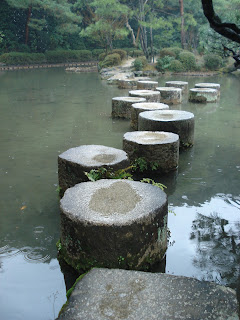
Stepping stones leading across one of the ponds at Heian-jingu. My favourite part? Not only are you allowed to cross on them, you are expected to.


With Kyoto Station and the much more modern downtown Kyoto located somewhat in the centre, the city can be divided into two main sightseeing areas, Higashiyama in the East and the quieter Arashiyama are in the West. This having been said, there is also quite a bit to see in the centre, as one of my favourite temples, Nishi Hogan-ji (free and open 6am-4:30pm), was located just northwest of the station. Also in the centre, though quite a ways North from there is the beautifully gilded Nijo Castle with its exquisitely painted interior (600yen, 8:45am-5pm, no pictures allowed but oh so worth it) and, a even further north of there, Kinkaku-ji with it's ever-famous Golden Pavilion (no, really! First constructed in 1397, the present structure was built in 1955 after an overzealous monk burnt down the original five years previous). Other things to see in the city centre include the lively shopping street extending westward from Yasaka Shrine as well as the Nishiki Food Market just north of there. The Nishijin Textile Centre (free, open 9am-5pm) to the north of Nijo is also worth a visit for anyone interested in traditional Japanese dress. The centre puts on several free Kimono fashion shows per day, contains a small textile museum, provides weaving demonstrations and, of course, has a display and sale area for their products. I don't recommend visiting the Kyoto Imperial Palace, it's closed to the public and, while the grounds are extensive, there is really nothing there. As a note, many of the places I just mentioned are not within walking distance. Trust me, I walked. I recommend either buying a day pass for the bus (around 600yen) or borrowing a bike for the day.

One of the world's largest wooden structures, the gilded main hall of Nishi Hogan-ji  made it one of my  favourite temples in the city. Sadly, despite it's proximity to the station and lack of entry fee, both it and equally splendid, equally free and  nearby Higashi Hogan-ji seem to get left off many tourist itineraries.
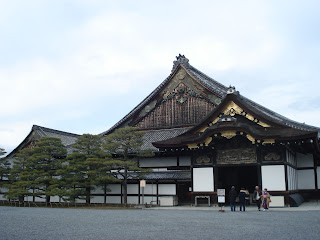
Ninomaru Palace in Nijo-jo, or Nijo castle. Built in 1603 by Shogun Ieyasu Tokugawa, first of the Tokugawa Shoguns, The exterior of the building may not look like much, but I would rank it among the top places to visit in Kyoto. The painted screens and ceilings inside are breathtakingly lovely (with many painted in gold) and the 'nightengale flooring' designed to squeak as you walk (even in your borrowed slippers) so as to warn off intruders, makes the experience even more interesting.

Kinkaku-ji's famous Golden Pavilion - originally built in 1397 as a retirement villa by Shogun Ashikaga Yoshimitsu, it was turned into a temple by his son as per his wishes upon his death. This is the 1955 reconstruction.

I was fortunate enough to be based in the Higashiyama area just to the East of the centre - most of the sites of which are within walking distance of one another - though if you plan to cover the whole area, be warned that it is a very long day. I was even more fortunate in that I managed to find an old traditional-style house - complete with tatami floors, futons, a supremely narrow staircase, an outdoor bathroom in the courtyard and old-style shoes to wear to get out there - in which to stay (for all those interested, check out Hostel Haruya, Higashiyama branch - the staff were wonderful). While I definitely recommend checking out some of the main sites in the area, I also recommend just wondering - I found a number of my favourite places that way.

The raked gardens of Ginkaku-ji, also known as the Silver Pavilion - although it was never covered in silver.  A fairly popular site, it was nearly impossible to capture a picture without people in it. The alternating bands of gravel in the front are said to represent the waves on the lake or sea, and the cone in the background the stillness of Mount Fuji by contrast.


The delightful cemetery and pagoda atop a hill at Kurodani  Temple. This area was so peaceful, and the view of Kyoto from the top of the hill so nice that i could have happily stayed there all day. As an aside, any traveller to Kyoto can't help but notice that many of the temples in the area are surrounded by cemeteries - in complete contrast to the areas surrounding Shinto shrines. A quick question to one of the English speaking monks I encountered garnered me the answer that the dead are considered as sources of impurity (in the sense of cleanliness) in Shinto and that purity is important when approaching the Kami spirits for help or advice.
The beautiful moss-covered gate at the stunningly dilapidated Honen-in.  Established in 1680 , this extremely quiet temple was stumbled upon as I was wandering off the Path of Philosophy.

The garden and Japanese style water-chain at Reikan-ji - another of the temples that I accidentally stumbled upon while ranging of the established Path.

Some of the painted screens on display at Reikan-ji. Although these are lovely, they  are nothing in comparison to those in Ninomaru Palace.

A traditional Japanese water drainage system, ensuring that temple roofs are not overwhelmed by the rain.


Yoshida-jinja. Located on a small mountainous hill in the northern Higashiyama  area, I stumbles across this one when I saw a red torii (Shinto gate) on a path leading to a wooded area while wondering lost in the back streets of Kyoto - streets which themselves are quite fascinating as they are filled with old-style houses.

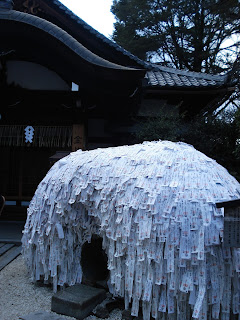
Yasui Kompiragu, another of the shrines I stumbled across, this one located at the south end of the Gion district, northwest of Kiyomizu-dera. Hidden in the backstreets and announced only by stone torii opening on to the road, when I first wandered up to the temple I was greeted by the sight of people in full business attire bowing, crawling through the hole, bowing once more and coming back through before pinning their prayers onto the rock. Interestingly, when asked why this was done I could get no straight answer, seems the sanctuary is linked to everything from traffic to health to riches and marriage. Research on the net in English seems to suggest that passing through once should bring about a good relationship, and twice a good divorce. Research in french on the other hand, links the shrine, supposedly established in 656, back to health and the curing of epidemics. I'm hoping someone who speaks Japanese will eventually be able to clear this up for me!
One of my absolute favourite sites, and one I definitely suggest checking out is Yasaka Shrine in central Higashiyama. It's always free and always open, borders on Maruyama Park, is beautiful both night and day and always seems to have a steady stream of people passing through to throw a coin, ring the bell and provide the ritual two bows and two claps to cement their requests - be warned that if you also plan to ask something of the kami being worshiped, you should probably make sure that you purify yourself first. This involves first washing the left, then the right hand, and then rinsing your mouth. There are always nicely decorated basins with running water at which to do this - just don't make my mistake and poor your used water in with the clean! Another of my favourites was Kiyomizu-dera, or Kiyomizu Temple. Built into the side of a mountain a kilometer or so south of Yasaka Shrine, there is a reason this is one of the UNESCO sites (and only 300yen as well!). Just to the left of the Kiyumizu-dera entrance lies Tainai-meguri which offers possibly one of the coolest experiences in Kyoto as you descend into a pitch black cave to be reborn (100yen suggested donation, try to go down when you can be alone). The area between Yasaka Shrine and Kiyumizu-dera is also worth a wander - if not more than one. Filled with narrow lanes and shop sellers offering up a taste of their treats, it's here that you are most likely to encounter those who have paid to be dressed as geisha for the day.

Two lovely shop ladies up near Ginkaku-ji offering up sweet samples.

Red bean, chocolate, strawberry and who-knows-what-else filled  rice pastries. I was given so many of these to try while wondering along the shop filled streets that I was nearly dizzy from sugar consumption. My favourite remain the red bean - although read bean and green tea are also quite tasty.
A tourist made up as a Geisha poses for me in the  streets around Kodai-ji. 
And another, this one in the tiny, but enchanting Yasaka Koshin-do Temple. If you look to the left, you may notice what look to be small coloured balls hanging behind her. In fact, they are small plush Kukurizaru, or hanging monkeys, who are folded in half with their hands and feet tied behind their backs as a reminder to those making a wish that in order for it to be fulfilled, they must control their temptations and desires.
Wandering the streets leading to Kiyomizu-dera.

The sky opening to shine down on Kiyomizu-dera, with it's view of Kyoto in the background.

Looking back toward the pavilion at the entrance.

The entrance to Jishu Shrine. Although this Shrine is located on the grounds of Kiyomizu Temple, it is not technically affiliated. This combination of shrine and temple is not actually all that uncommon in Japan, with traditional Shinto and introduced Buddhism having a long and intertwining history in the country - particularly after  Toyotomi Hideyoshi brought the two closer together in an attempt to block Christianity from gaining ground in the 16th century. Interestingly, syncretism of the two religions was declared illegal during the Meiji Restoration of the 19th century (when the Emperor was nominally returned to power after centuries of rule by the shoguns) so that state Shinto could be used to reinforce to order of society. 

A woman prays at the main shrine in Jishu-jinja . Jishu is a popular destination for those seeking luck and love. I loved the way the riotousness of the shrine contrasted with the staid tranquility of the temple surrounding it.

Two stones of which it is said that, if you can walk from one two the other with your eyes closed  on the first try,  your true love is sure to be soon revealed. At the far end you can see a group of teal-clad Taiwanese students helping (and in some rather amusing cases, hindering) each other's crossings.
Located even further south of here (take the train or subway) is Fushima-Inari Taisha, a breathtaking temple complex dedicated to Inari, goddess of the rice harvest (and thereby sake and business as well). Established in the 8th century, the most fascinating aspect of the complex are its 4km of mesmerising mountain pathways winding under seemingly endless amounts of bright red (though some might call it orange) torii (Shinto shrine gates).


A stone fox, messenger for Inari, guards one of the gates at Fushima-Inari Taisha.

Beginning my wander through the never-ending red torii.

As for the Arashiyama region to the Northwest of Kyoto, while it must be lovely during the summer, located as it is on a floodplain surrounded by mountains, and preserved as an escape without many tall buildings, I'm sure it must be absolutely lovely in summer. In truth, by the time I made it out to Arashiyama, I was nearly completely templed-and-shrined-out. My chief goal in heading there was actually to pay a visit to the Iwatayama Monkey park. Located a-top a fairly steep though not overly tall hill, the park allows visitors to not only get close to Japanese macaques that are native to the area, but provides a beautiful view of the city as well.

We passed these two en route up. The keeper told us that they were two of the most friendly. Left to their own devices, the hundreds of monkeys on the mountain are surprisingly nonchalant about having people invade their home - provided of course that you don't go about provoking them.

Although it may not look it. It is actually I, and not this adorable little dude, who am in the cage. In order to allow visitors to safely feed the monkeys, they (both visitors and monkeys) have all been trained to understand that snacks are only given by caged people to free monkeys, and not under any other circumstances.

Looking out toward Kyoto from my people-cage. After sufficient time  spent feeding them, I want out to wander amongst them. They were just fascinating to watch. Sadly (or fortunately?), they did not seem to be anywhere near that interested in me.