Showing posts with label South Korea. Show all posts

Tuesday, March 5, 2013

Farewell Gwangju

Sadly, all good things must come to an end. Time's come to say Goodbye Korea, Hello world. I am really going to miss this place! 

A picture of my empty classroom *sniffles*

안녕히계세요! Until next time!

Tuesday, February 19, 2013

Muju! Skiing Korea

This past New Years Day (the Gregorian New Years of about a month and a half ago that is, not the Chinese New Year that took place this past weekend), I decided to take advantage of both the snow squall and the day off work to partake in one of my favourite activities, and one which has become somewhat of a New Year's tradition - Skiing!!!

Teaching the beginners at Muju.

Friends of mine had heard of a fairly cheep bus service, lift ticket and rental package (of both winter clothes and skis/boarding gear) all for under 100USD to the nearby resort Muju (무주) on Mt Deogyu (덕유산). Although not a huge mountain (Deogyusan's highest peak is at 1,614m, but the resort does not extend that high up), Muju has 34 runs -  including a few nice long ones down from the resort's highest peak (the longest is 6.1km) - and provides great skiing for those at the beginner and intermediate levels. It's not phenomenal for advanced skiers, but the harder runs (steepest is 60degress) do offer up some fun. It's central location on the peninsula also makes it easily accessible from just about anywhere in Korea.

As we went during a snow storm, we were also blessed with some great snow - which felt a lot more like biting ice in the high winds at the top. Nevertheless, we had a thoroughly enjoyable day on the slopes - made even better by the fact that Muju is open early until late! I have to say, there is definite merit in a ski hill that has its lifts open from 6:30 in the morning until 2am the next. Definitely my kind of hill!

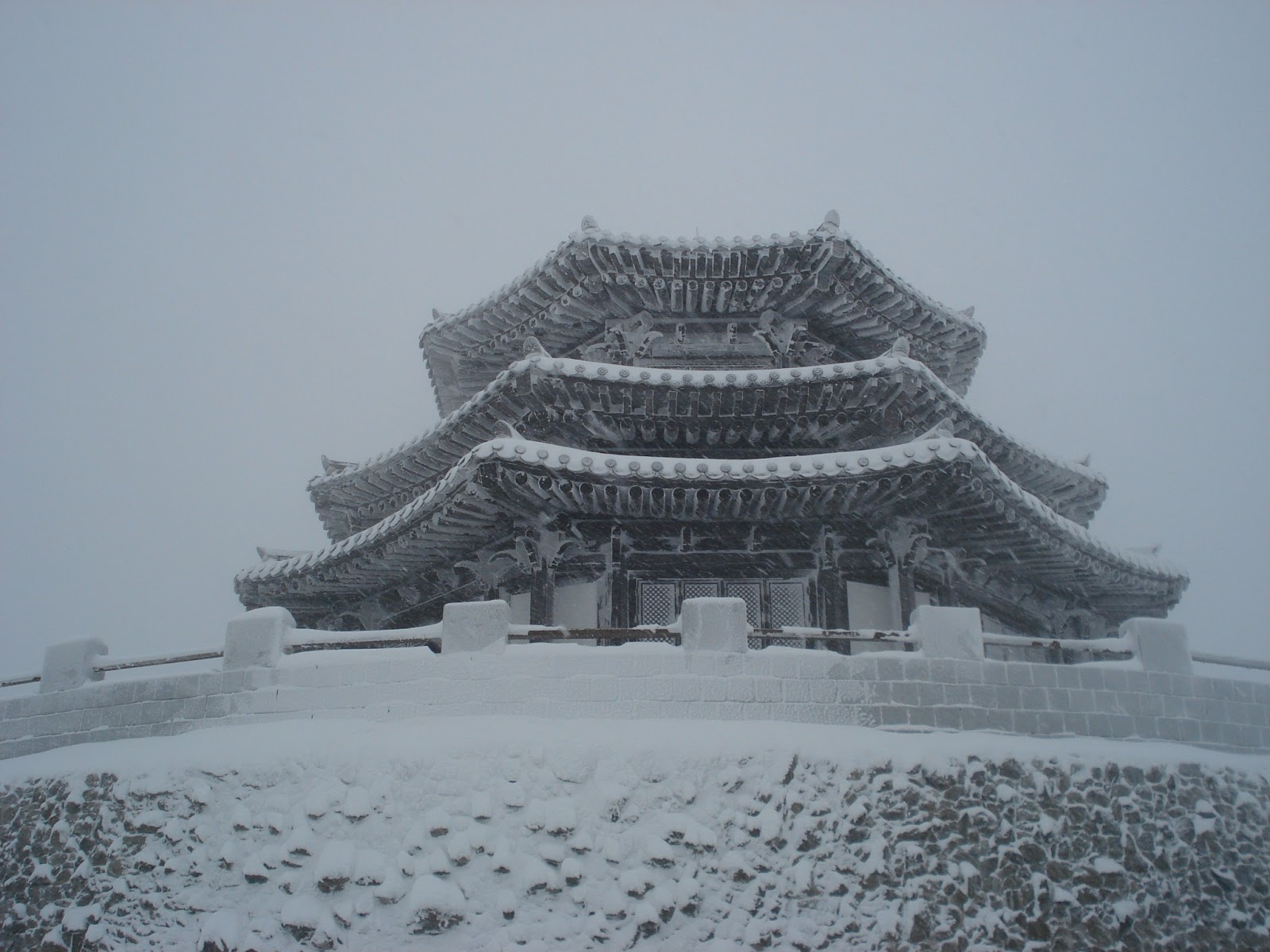
A nicely frosted pagoda up at the top.
Anyone living in Gwangju who is looking to head over to Muju should check out (or have a Korean speaker check out) the packages here. You can also call 010-3648-7761 (Korean only). Muju's website can be found here (English option at top right).  

Volcanoes in the Snow - Hiking Hallasan

Truth be told, while I was eager to enjoy the other delights the Island has to offer, my primarily reason for visiting Jeju (and that of my companions as well) was to hike Hallasan (한라산) and complete the Korean hiking triumvirate of Jiri, Sorak & Halla.

Looking toward the peak from the Sara Crater detour.
Although Hallasan, at 1950m, is the tallest of Korea's three major mountains - and, indeed, of all of Korea's mountains - I would say that it offers the easiest hike for it's size.

My companions en route - these two are off to Nepal next - sooo jealous!
Quite possibly the best sign ever. We found this one on our route down.

Hallasan is home to a number of trails, only two of which reach all the way to the top. The 9.6km Seongpanak (성판악) route on the eastern side of the mountain, winds it's way mostly through the trees, providing a nice, gentle ascent. The 8.7km Gwaneumsa (관음사) route on the northern side by contrast, is a stunning but narrow trail with a great many stairs and a number of ups and downs. Knowing this, we chose to take the gentler route up and the harder route down. This proved to be a wise decision as most of the Koreans who went all the way to the top, also chose this route. 

Walking through trees on the Seongpanak ascent.
Our route choice proved to be a good one for another reason as well. About halfway up the Seongpanak route there is a 45minute detour to Sara Crater Lake (사라 오름-Sara Oreum) and a lookout point. Although the clouds mostly obscured the view from the lookout point, the crater and it's frozen lake made quite a pretty sight. 

the boardwalk lining Sara Oreum
Overall, the hike was absolutely gorgeous - possibly made even more so by the snow. We were also lucky in that we had a gorgeous clear day (above the cloud line that was) and not too much of the blustery wind that Jeju is so famous for. It should be noted that if you are planning to hike it in winter, cramp-ons are an absolute necessity (particularly on the way down). We picked ours up at the Seongpanak park entrance for about 10,000won ($10US). Nicer, more expensive ones were also available.

Windswept snow at the top.
More proof of Jeju's strong winds. This is on the northern side.
A further note for any planning to hike to the top - there are checkpoints on the mountain that you must pass by a certain time in order to be allowed to continue. A time sheet (along with route info) can be found here. We started off from the base at around 8:30 and had no trouble reaching the upward checkpoint by noon, even with our detour. The full round trip (with some rest time at the top and one of the shelters further down) took us until about 5pm at a moderate pace.

Up at the top.

Not what you expect from the peak of a volcano!

Monday, February 18, 2013

Jeju Island: Exploring a Gem of the Pacific

Last week, two friends and I decided to take advantage of our final long weekend in the country during Seollal (설날) - also known as the Lunar New Year - and hop on a ferry to what is reputed to be the most beautiful place in all of Korea - Jeju-do!

Recreations of the famous Jeju hareubang statues.
For those who don't know, Jeju (제주) is a small (73km by 41km) oval-shaped volcanic island 130km off the southwest tip of the Korean peninsula. Famed for it's beauty and often called 'the Hawaii of Korea', Jeju was recently named one of the New 7 Wonders of the Natural World - and I have to say, even in winter, Jeju lives up to it's hype.

Exploring the rock formations on the southern coast of Jeju.
While the 2 million year old island is literally littered with mini extinct volcanoes (360 of them to be exact), volcanic craters and lava tubes surrounding the main volcano of Hallasan (한라산) - also Korea's tallest mountain, coming in at 1950m (more on that in the next post!) - these are only part of what make the island so spectacular.

In addition to having a unique geology, Jeju's relative isolation has given it a unique cultural history. While Jeju was eventually annexed by the mainland Goryeo Dynasty in 1105 and the Mongols after that, then returned to Korea with the takeover by the Joseon Dynasty (who used it as a place to send political exiles) in 1404, and thus has shared much of it's more recent history (such as Japanese occupation) with the mainland, prior to this, Jeju-nese history is somewhat of a mystery.

Cheonjiyeon Falls (천지연 폭포) from a distance. You can see Hallasan rising into the clouds on the right.
Very little is known about the pre-Goryeo Tamma Kingdom and how it came to be. Island legend states that the three demigods: Go, Bu and Yang, rose out of the ground and became the islands first residents. When the three men were out hunting one day, they ran across three princesses who had washed ashore with all of their agricultural accoutrements and livestock. Marrying these three women, the hunters settled down and established the three main agricultural clans of Jeju island. The hole in the ground from which the hunters emerged can still be visited at Samsunghyeol Shrine (삼성혈)- which remains an important location for the seasonal ancestral rites performed by their descendants - in Jeju City.

A stone ring and tripple alter surround the hole through which Go, Bu and Yang entered Jeju at Samsunghyeol.
Other unique features of Jeju-nese culture include thatched roof houses - although these can only be seen today in the preserved traditional 'folk villages', the inexplicable ancient basalt mushroom-like grandfather statues called Dol Hareubang (돌 하르방) which dot the island, the hand-stacked stone dividing walls to allow for Jeju's famous winds to pass through without toppling them and, last but certainly not least, the haenyeo (해녀) - Jeju's famous women divers. Although now somewhat of a dying breed, women began to do the work of diving into the waters along the coast to collect shellfish in the 19th centuries when their husbands discovered that their families would be tax exempt if they did so!

As interested as I am in culture, as much as I loved hiking Hallasan and as fascinating as the publicly accessible portion of the lava tubes at the UNESCO World Heritage Site of Manjanggul (만장굴), geologically speaking, it was the coastline that took my breath away!

Looking toward Munseom (island) from some of the Rock formations along the coast in Seogwipo.
While the northern coastline around Jeju City (제주시) has some fun rocks, it's the south near Seogwipo (서귀포) that is really stunning. Not only is the area around Seogwipo studded with waterfalls, to the West of the city lies the resort area of Jungmun (중문), home to Korea's Jusangjeolli (주상절리) or  'Black Beach', made of hexagonal basalt formations reminiscent a smaller version of the Giant's Causeway connecting Scotland and North Ireland. While Jeju's Jusangjeolli is not as large as the Giant's Causeway, the emerald blue (no, really, that's the only way to describe the colour!) water the rocks rise out of makes it breathtaking to visit.

Jusangjeolli. The colour of the water made me nearly desperate to jump in - and it was February!

Jungmun is also home to Yakcheon Temple. While I have seen a lot of temples during my time in Korea, Yakcheonsa is ranks up there with my favourites. Done up in a more ornate style that reminds me more of the temples I've seen in Taiwan than any I've seen in Korea, the combinations of pastels and golds, as well as the amazingly detailed latticework carvings on the windows made a visit well worthwhile.

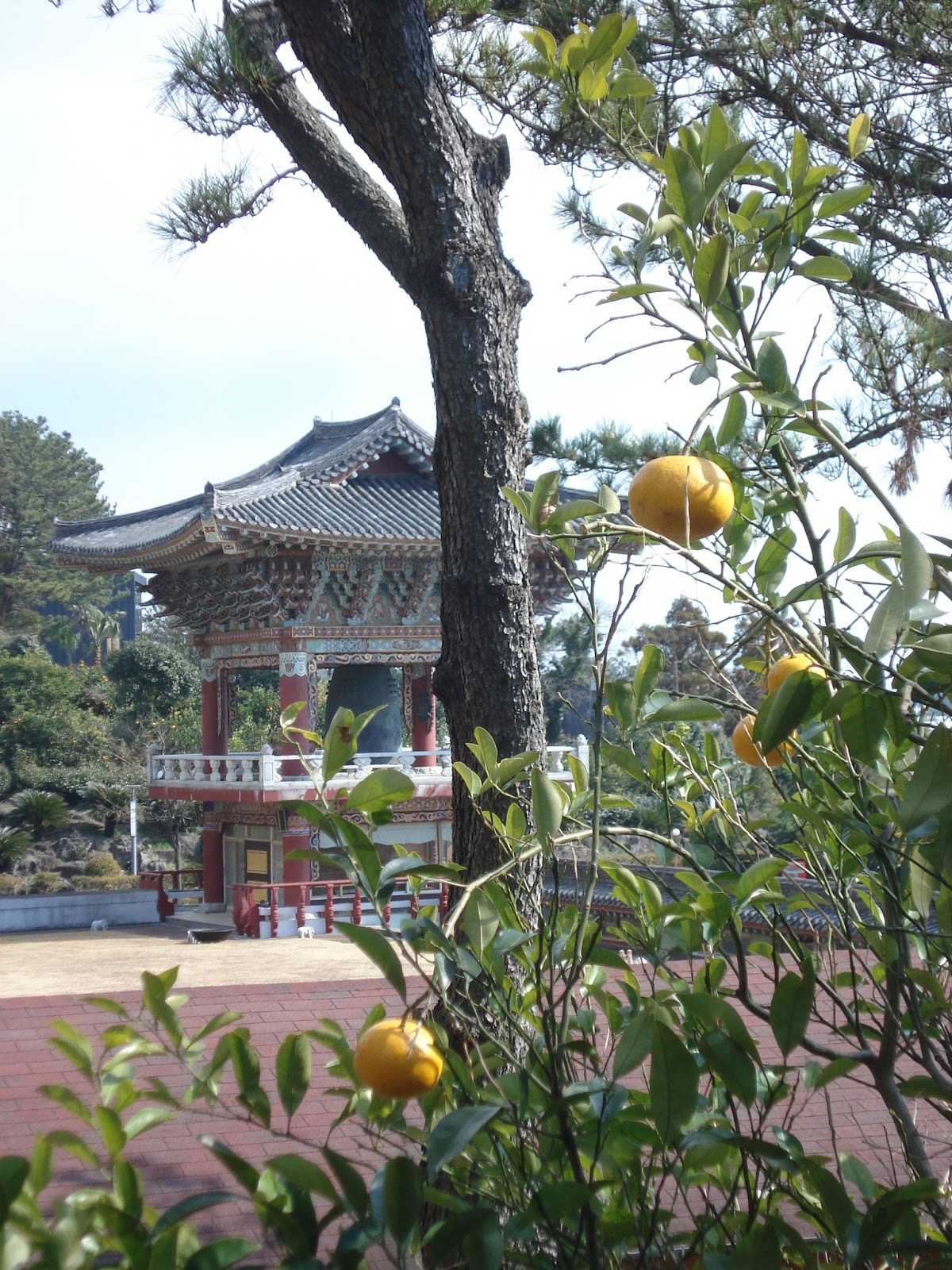
The bell tower at Yakcheonsa with oranges in the foreground. In addition to being famed for it's beauty, Jeju is famed for the deliciousness of it's oranges. Sadly, I was there a month too early for these ones to be ripe.

The giant gold Buddha inside Yakcheonsa. The great hall is said to be one of the biggest in Asia. With three floors of viewing galleries, each surrounded with painted panels depicting stories, I may well believe that.
Even further to the west along the southern coast was quite possibly my favourite spot on the island - the Yongmeori (용머리 - dragon's head) Peninsula. While it's invisible until you are down there and closed off at high tide, the coast below Sanbang peak (삼방산) if formed of weathered vocanic cliffs and caves that just bed to be explored. This is also where the monument to Handrick Hamel - the Dutchman who washed ashore on Jeju in 1653, was captured and enslaved, eventually managed to escape with 7 others in 1666, and wrote a book bringing news of life in the Joseon-era Hermit Kingdom of Korea to the rest of the world - and recreation of his ship are located. The small Mt. Sanbang itself is also worth a visit as it is home to Sambanggulsa (삼방굴사) or Sambang Cave Temple.

Looking toward the Yongmeori Coast from Sambang Temple. Hamel's ship is just visible in between the temple and coast.
A view of Hamel's ship through his momument.

While Jeju is fairly small, the sheer number of protruding mini volcanoes can make getting around the island somewhat time consuming. It's possible to travel by public transport, but having a car (and in smaller areas, bikes) might be more convenient (you need an international drivers licence though). We were lucky enough to stay in a wonderfully accomodating hostel (the owner even fed us traditional New Year's Tteok-guk (rice cake soup) on Seollal!), which offered cheap tailor-made driving tours. You can check out B&B Pan here. The island is also crisscrossed by 'Olleh Trails', 200km of connecting walking trails which have been divided into 13 different routes - although on many you can jump it at any point along the path.

Looking back toward Sanbang while walking the coast.

Some of the formations on the Yongmeori coast. This one is about three times my height.

Some more of the crazy geological features.
There are a number of ways to get to Jeju. Flights leave from most of the larger city airports on a daily basis and ferries, from Incheon (Seoul, 14hrs), Mokpo (4hrs) and Wando (3hrs), to Jeju City on the North Coast leave just as frequently. The fastest Ferry, and the most convenient for us, is the JH Ferry run by Orange1 which leaves from Jangheung (장흥), near Yeosu in southern Jeollanamdo, and arrives at Seongsan (성산) on the west coast of the Island in 2 and a half hours. There is also a free shuttle bus run by the ferry company which connects Gwangju to Jangheung. Their website is here. Unfortunately, it is entirely in Korean.

A view of Ilchulbong (일출봉), or Sunrise Peak in Seongsan on the East Coast at Sunset.

Monday, December 10, 2012

A Week in School Lunches

Since so many people have asked me what we are fed for lunch at school, I decided to do a post about a week's worth of middle school lunches. It should be noted that we eat the same things as the kids - though they always complain that we get more, which, to be fair, is true, they don't get to go back for seconds ;).

Going clockwise from 12 o'clock, we have pork stewed in vegetables and oyster sauce (굴소스돈육불고기), a spiced mixed green and onion salad (가랏겉절이), kimchi and bean sprout soup (김치콩나물국), rice with barley (보리밥), and dried fish and almonds in a sweet and spicy dressing (아몬드쥐손채볶음) - Soo yummy! There was also yogurt served with this meal, but as a lactose intolerant, I did not partake.

School lunches in Korea (and much of Asia) always seem to be served in these specialised metal trays. The smaller deeper bowls at the top are for your side dishes, or banchan (반찬), while the shallower, more central indentation is meant for the main dish. The usages of these three receptacles do seem to be somewhat interchangeable however - particularly if the main course is saucy or there is a flat side or dessert served.
 
Tuesdays main dish was mackerel in a boiled kimchi sauce (묵은지고등어조림). (I cannot adequately express my love). As sides, there were Lotus roots simmered in sweetened soy sauce with toasted sesame seeds (연근조림 - top right), the ever-present kimchi (also top right) and spicy chicory, cucumber and octopus salad (치커리오이초무침 - top left and sooo good!). This was accompanied by a baby clam, potato, noodle and vegetable soup (바지락감자수제비국 - also delicious) and 'eco' brown rice (친환경현미밥). Dessert (not pictured here for intolerance reasons) was 'creamy cheese corn' (옥수수콘치즈구이). Apparently it's very tasty. I'm not so sure. 

The lower two bowls are reserved for rice and soup. The rice is always placed on the left and the soup on the right. Don't mix these up, you will get a ridiculously large number of strange looks if you do! (And this from people who didn't flinch when I started photographing my lunches!). As with all Korean meals, you are also given a spoon and chopsticks. The spoon is for both the soup and rice, while the chopsticks are for everything else. Eating your rice with chopsticks will garner you looks just as strange as if you'd put your soup in the wrong bowl.

Occasionally, the main dish, due to it's nature, will need to be placed in one of the larger slots - or, as in this case, in a bowl in one of the larger slots - in that case, many Koreans will simply fill one of the banchan bowls with rice. In this photo, the main course is in the bottom left-hand corner and is a Korean-ified Chinese dish called Jajangmyeon (자장면), or noodles with peas, carrots and beef cubes in black bean sauce. As sides we had a fried breaded shrimp in a sweet and spicy chili-peanut sauce (깐쇼새우 - sooo good!), cabbage kimchi, cubed radish kimchi (깍두기 김치), and sweet (yellow) pickled radish (단무지). The soup was (oddly not listed on the menu) a broth with shrimp, seaweed and green onions. In the top right corner you can see some asian pear (배) for dessert.

 Both rice and soup are present at every meal (even when I don't take any as the main dish is noodle based as above). The rice is left plain so that you can used it too soothe your poor tongue should any of the other food prove to be too spicy (as is often the case - though I am also partial to mixing my sides into my rice). The soup can also be used to serve this important function. It's mainly there for another reason however, Koreans don't believe in drinking water while eating! (Though they do believe in drinking alcohol... hmm...) This is so that you have space in your stomach for food. Water is often drunk after the meal. I don't know about you, but personally, I get thirsty when I eat!

In this instance, my main dish is located in the top left corner bowl, and it is absolutely delectable steam-braised pork short ribs stewed with dates and grapes (돼지갈비찜). The sides on offer included the inevitable kimchi (not pictured here), salad with chili-paste dressing (성추겉저리), whole rice (쌀밥), and seaweed soup (미역국). For dessert, we had delicious almond and orange rind cake and oranges.

Another element which is present at every meal is kimchi (김치), or fermented cabbage dressed in spicy chili sauce. While I don't necessarily add it to my dish every time, a number of the other teachers will fill their banchan bowls to overflowing with kimchi (and look curiously at me when I don't - similarly, they always say I don't take enough rice!). If you look carefully at the upper right hand bowl two pictures above, you'll notice that I not only had normal cabbage kimchi, but kkadugi (깍두기 김치), or cubed radish, kimchi as well.

And for the final platter, we had seafood patties in oyster sauce (해물동그랑땡 - a lot more delicious than you might expect!). Our sides were wasabi beansprout and crab salad (와사비 콩나물무침), kimchi and tiny dried whole anchovies in a spicy sweetened sesame sauce (멸치 조림 - also a lot better than you might think!). Rice was plan white, while the soup was a variation of my favourite - jjigae! In this case, it was tuna jjigae (참치 찌개) but pork, beef and kimchi jjigae are all also common.

Overall, I find my school lunches to be varied and super delicious - all the more so as they only run me 3,000 (or $2.75 US) per day. This is likely a good thing as eating lunch in the cafeteria alongside all of the students and other teachers is seen as being an integral aspect of participation in school life. This is so much the case that it is seen as terribly rude to leave the table before everyone in your group is finished - especially if that would leave one person sitting alone.

잘 먹겠습니다!
(Jal Mokgetsumnida! - Eat Well!)


Author's Note: A Massive THANK YOU! to science teacher 박형도 for helping me identify and name all of the foods!!! 감사합니다!!!

Sunday, December 9, 2012

Walking in a Winter Wonderland - Mudeungsan in the Snow

Okay, so I may have lied when I said hiking season was coming to a close. Clearly I hadn't adequately considered the potential in combining two of my vary favourite things (No, not food. Though with me, that's always involved.) - hiking and snow!

Setting off from Jeungshim Temple (증심사).
This past weekend, a few friends and I decided to take advantage of the fresh snowfall to check out the views of and from Gwangju's Mt Mudeung (무등산) in the snow. Rather than taking the 1187 bus halfway up and doing the ridgewalk to the top, we decided to start right from the bottom at Jeungshim Temple so that we could stay warmer under the tree cover. We wound up hiking to the top via Jungbong (중봉- Jung Peak) and looping back around on our way down so that we could hit the famous Ipseokdae (입석대) rock formation on our way back to our starting point. Overall, the hike covered about 8 or 9km took us about 5 hours with all the snow.

A view of the city from partway between Jungmorijae and Jungbong. About 800m up.
It seemed like much of the older population of Gwangju was also on the mountain to play in the snow for the day - small wonder as brisk winds kept the clouds moving fast so that we often had clear blue skies.

Playing around in the snow en route.
As per usual, any time the locals glanced down at our feet and realised that we weren't wearing 'proper Korean hiking gear' (in this case cramp-ons and brightly coloured knee-high waterproof leg warmers - no joke!) there was a lot of clucking and shaking of heads in dismay (in my case, this may have been justified, my hiking shoes officially died yesterday, so I was hiking in dress boots - they were nice and cozy and warm though!).

Looking up toward the Seoseokdae (서석대) rock formation near the top. Standing on top of this at 1105m is the highest you can get on Mudeung as the peak (at 1187) is occupied by the military and cordoned off to the public.

Fortunately for us, the snow was still fresh enough that our lack of cramp-ons was in no way a factor (though it did make 'ski-ding' down the mountain at the end much more fun) and many of those we encountered were just happy to see foreigners so enjoying their mountain.

A view of the Ipseokdae (입석대) formation. They are huge! To give you some idea, if I were standing at the base of that pillar, my head still wouldn't make it into the picture!

Such a great day! There's nothing quite like going out to play in it to remind you just how awesome snow is!

Descending into a snow-covered Jeungshimsa on our return.

Bibimbap!

So it seems that now that hiking season is coming to a close, I've turned to blogging about one of my other favourite things - FOOD! Or, in this particular instance Bibimbap (비빔밥)!
 
A photo of my school's bibimbap. You may not be able to see all the ingredients, but this one includes rice, fermented radish strips (buried under the rice), mushrooms, bracken fern stems (고사리 - gosari), soybean sprouts, zucchini, seaweed, lettuce, sesame seeds, sesame oil and gochujang (fermented red chili paste) with ground meat. It's delicious, if it doesn't look it, I'll take the blame. I'm the one who prepared it ;).
Bibimbap literally means 'mixed rice' ('bibim' means 'mixed' and 'bap' means 'rice'). It's a dish you will find all over Korea in a number of variations. In Jeonju (전주), Jeollabuk-do province this variation includes a raw egg and is said be how it was traditionally served during the Joseon Dynasty. Another variation is Stone Pot Bibimbap (돌솥 비빔밥- dolsot bibipbap) which is served in a (surprise!) steaming hot stone pot. In the northern province of Gangwon-do, wild mountain vegetable bibimbap is the signature dish, while elsewhere beef may also be added. Here in Gwangju, it is also common to stumble upon spicy seafood bibimbap, which is one of my favourite variations.

The above bowl once mixed. This is making me ridiculously hungry.
Wherever you eat it, there are a few ingredients which will almost inevitably be present. The first, and most obvious of these, is rice, but a good bibimbap will also contain zucchini, cucumber, spiced radish strips, mushrooms, soybean sprouts, seaweed, bellflower root, bracken fern stems, sesame seeds and oil and, of course spicy chili pepper paste (often this is 고추장 - Gochujang, or fermented red pepper paste). Bibimbap is almost always served unmixed, with the ingredients arrayed attractively around the bowl. In many restaurants, the rice will be served in a separate lidded cup. It is up to the customer to mix it to their satisfaction.

Ddeok! A delicious Korean rice-based dessert.

While the above picture is not of bibimbap, it is of an equally typical Korean dish - Ddeok (떡), or rice cake. This particular assortment was given to one of the other teachers in my office as a 'thank you' from one of her student's parents. The giving of ddeok in thanks, in celebration or as a parting gift is a fairly common practice in Korea. In its most basic form, ddeok is made from glutinous rice flour and can take on many forms - both sweetened and not. In the above picture, both forms are intended to be eaten as a dessert or snack. To left is ggul tteok (꿀떡), or honey and sesame filled ddeok, while to the right is injeolmi (인절미), or steamed and pounded rice cake coated with soybean powder. Both are delicious.

Monday, November 26, 2012

Persimmons!

So it's now nearly December and I have yet to do a post on what has quickly become one of my favourite features of fall in Korea (see what I did there?) - Persimmons!

A 단감 (dan gam) or fuyu persimmon - washed and awaiting my consumption.

I have to be honest, before coming to Korea, I had little - if any - notion of what, exactly, a persimmon was. I think I knew that it was some kind of fruit, and I recall having some vague idea that people ate them dried, but I could not have told you where they were from, what they looked like or how they tasted (nor when they were ripe or why people ate them if it came to that).

One of the persimmon treas at Baegyangsa in Naejangsan National Park.

I am happy to say that all of this has now been rectified. I now know that persimmons - or 'Gam' () with a hard 'k'-like 'g' as they are known here - are an amazingly delicious and wonderfully fantastic fruit that no one should ever have to live without. I love them. I want to eat them all the time.  Not enough of an explanation for you? I suppose I could try to go in for a little more detail ;).


More persimmons, all for me! Their exteriors are waxy cuticles that are reminiscent of the skin off an apple - though slightly tougher - and just as edible. Many Koreans will peel and slice their persimmons. This requires more patience than I care to exhibit.

Before I go any further, I suppose I should mention that there are actually two types of persimmon available in Korea. Hachiya persimmons (떫은감 - tteolbeun gam or 'sour persimmon') are deep orange, sweet, soft and pulpy when ripe, but very bitter before that. By contrast, fuyu persimmons (단감 - dan gam or 'sweet persimmon') are lighter orange in colour and have a crisp melon-like texture, they are also (rather entertainingly because of their name) less sweet. Having not yet tried the hyachiya persimmons, it is the fuyu persimmons that have so captured my heart (and tongue). As far as I'm concerned, they taste exactly like Christmas - or, rather, how I imagine Christmas would taste were it made into an edible flavour. It's like having melon, pumpkin and cinnamon-y pie spice all mixed into a deliciously delectable fruity bundle. I was initially hesitant to give them a try as I am what is often referred to as a 'texture person', being rather picky with my food in that department, but I am so glad I did! When just ripe, fuyu persimmons have an apple-like texture. From there, they migrate toward melon-like as they get less crisp. Interestingly, just like tomatoes (which they actually resemble quite closely), persimmons are technically berries. Sadly they are only available for a very limited period of time, appearing at local markets in early fall and disappearing again around this time (early December). Happily, when they are around, they're around in an abundance - and I plan to eat my fill!

Thursday, November 22, 2012

Palyeongsan: Where the Mountains meet the Sea

Located on the tiny little dingleberry-shaped peninsula of Goheung county (고흥군) is Palyeongsan (팔영산) National Marine Park and Recreational Forest. For me Palyeong Mountain itself was the real draw- not for it's height (it's only 608m at its highest peak), but for the stunning views it affords of the innumerable islands to the south.

The island view from one of Palyeongsan's peaks.
In addition to providing spectacular views, Palyeongsan provides oportunities for a wonderfully fun hike. Named for it's 8 peaks (팔 or 'pal' means 8), the trail involves a lot of going up-and-down and, as the peculiar rock formations which make up the peaks are particularly... well... rocky, there is a lot of scrambling/low level rock climbing involved as well (with chains and footholds in place as optional aids). So much fun!

Looking back toward the Korean hikers on Yuyeongbong (유영봉), Peak Number 1 of Palyeongsan, from Seongjubong (성주봉), or Peak Number 2.

The view of Yuyeongbong when not zoomed in.
Since the mountain is not particularly large, the hike can be done in only a couple of hours (even, if, like me, one is hiking on a sprained ankle. Required Safety Note: Do not try this yourself ;).). We started off at the Goheung Ranger Station near Neunggasa (능가사 - Neungga Temple), went up (and down, and up, and down, and up - well, you get the picture) over the peaks (heading westward), out to the highest point at Gitdaebong (깃대봉). We then took the lower trail to circle back for the return. It's also possible to continue forward for an additional 4km, which would bring you to the Nampo Museum (남포미술관) /Yeongnam Elementary School (영남초교) park entrance. Both park entrances have local buses going past. All in, our looping route was approximately 8.6km and took about 3 hours 30 mins.

Looking northward and inland.

The view eastward from Orobong (오로봉), or Peak 5.
While summitting and descending so many peaks in such a short space of time is thoroughly enjoyable, I have to warn anyone planning to hike Palyeongsan to go on a weekday. Because the hike is not too long and affords such great views, it's absolutely packed to the gills with Koreans on the weekends. On the bright side, if your aim is to immerse yourself in local culture and avoid foreigners at all costs, this would be the perfect place to do it! Korea doesn't get much more charmingly rural than Goheung-gun.

A view of the 8 peaks in the distance from the campground at the base of the mountain.

To get to Palyeongsan, hop on an intercity/express bus to Gwayeok (과역) or Goheung (고흥). The park is a short local bus ride from there. Gwayeok is located approximately 2 hours south of Gwangju (by bus) and Goheung is a little further on. The bus ride alone is worth the trip. The initial bit is slow moving and winds through some small towns (which are adorable in their own right). The views along the latter half of the route, however, are absolutely stunning! The locals in the area are also supremely friendly - they colluded to insure that a scarf I had forgotten on the local bus was returned to me when we got to the Gwayeok bus station at the end of our hike! 

Tuesday, November 13, 2012

Beagyangsa & Reflections of the Fall

Last Monday, it was time, once again, for a teacher wellness expedition. As per usual at my school, this involved food and hiking - fortunately for me (as last Monday was the day after my 46km Jirisan hike), this time the hike was much more of a leasurely meander along stunningly reflective river-pools. 

One of the Baegyangsa Pavilions and it's reflection.
This particular teacher wellness hike saw us head out to the Baegyang Valley, home of Baegyang Temple (백양사), in Naejangsan National Park (내장산) - about an hour and a half north of Gwangju. Baegyang is famous for a number of things, the two most notable of these - particularly in the fall - are its persimmons (mmmm, persimmons! - more on those another time) and the spectacular colours of its leaves. I have to say, while I've seen a number of sumptuously coloured valleys in my time here thus far, Baegyang thoroughly deserves its reputation.


Looking toward Naejang Mountain.

Some of the riotously red leaves. I love just how many different colours there are in this one tree!

A doorway leeding to one of the cemetaries in the area.

A close-up of the path stones.

I just loved the myriad of colours in this shot.

Looking toward Baegyang's persimmon, or gam (감), grove.

One of the temple buildings.

Can't get enough of the combination of real and reflected.

Heading back from whence we came en route to dinner - which was comprised of surprisingly delicious prepared local roots and shoots.