Tuesday, September 4, 2012

Wonsan & The North Korean Countryside

A view of the countryside.
I was fortunate enough to have time to visit, not only Pyongyang, Kaesong and the DMZ, but The eastern port city of Wonsan as well. Wonsan (원산), is the capital of North Korean portion of the beautifully mountainous Kangwon province (강원도). It has seen several centuries of history as a port city, though you wouldn't know this to look at it as it remained under siege for the entire duration of the Korean War (March 1951 to 1953) with nearly nothing remaining of it by the end. Wonsan is a popular destination for North Korean holiday-makers (Yes, they do go on holiday! Many take the train from major cities or simply wait along the roadside by their farms for suitable transportation to come along. Kim Jong-il also had a nearby villa.). Wonsan is famous in the DPRK for a number of reasons, not the least of which is it's presence next to the lovely Songdowon Beach (송도원) and it's proximity to supposedly stunning Ulim waterfalls (sadly, the road had been washed out by recent rains, so we didn't get the chance to go). Other nearby sites which are much more interesting for the few foreign tourists who visit than they are for DPRK citizens are the Songdowon International Children's camp, where youths from Russia and a variety of African countries still come to spend a few weeks in the summer getting to know their North Korean compatriots, and Chonsam (천삼) Co-operative farm, one of the only working farms which foreigners are currently able to visit.

My visit to Wonsan, combined with taking the train out through the northwestern town of Shinuiju provided me with ample opportunity to enjoy views of the countryside in the southern and western portions of the country. This opportunity was made even better when we encountered a blocked tunnel en route to Wonsan and had to wait nearly an hour alongside the locals while it was cleared by the army.


Waiting at the tunnel.

The farmers about their business.


Heading to work.

Working the fields.

Local transport.

Songdowon Beach & Dive Towers

DPRK Sail Boats.

Playing volleyball with the North Koreans, I didn't join in this game (I'm notoriously bad at Volley Ball). I did join an earlier game of soccer/football (no pictures for the obvious reason that I was otherwise occupied) with some electrical engineering students from Pyongyang - two of whom spoke wonderful English!

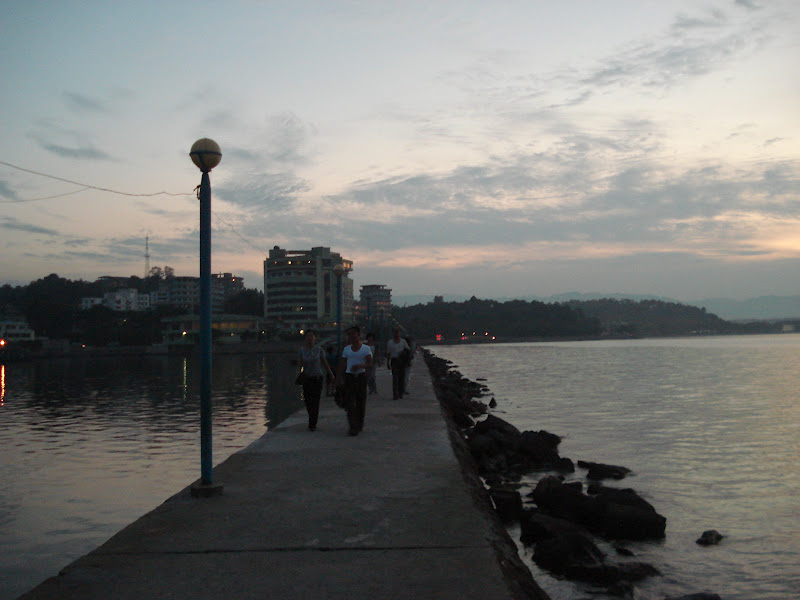
Heading out to the pier leading to the lighthouse on Jangdeokseom (장덕섬) Island at sunset.

Most rickety suspension bridge I've ever encountered. You could hear it creaking in the wind all night long.

A rusted old boat now used as a BBQ place and mini shellfish market by the locals.

A little further along the pier, women were clamoring for us to join them in their meals.


A lone fishing boat.

Looking back along the pier toward Wonsan.

Cheonsam Co-operative Farm. One of the features of the entire countryside is the uplifting inspirational music and discussion blaring through speakers placed in all of the fields. 

Their cultural hall/movie theatre with the mosaic of Kim Il-sung's visit and on the spot guidance to the left.

Rankings and Propaganda.


Movie Poster

A close up of the mosaic. The workmanship on these is incredible.

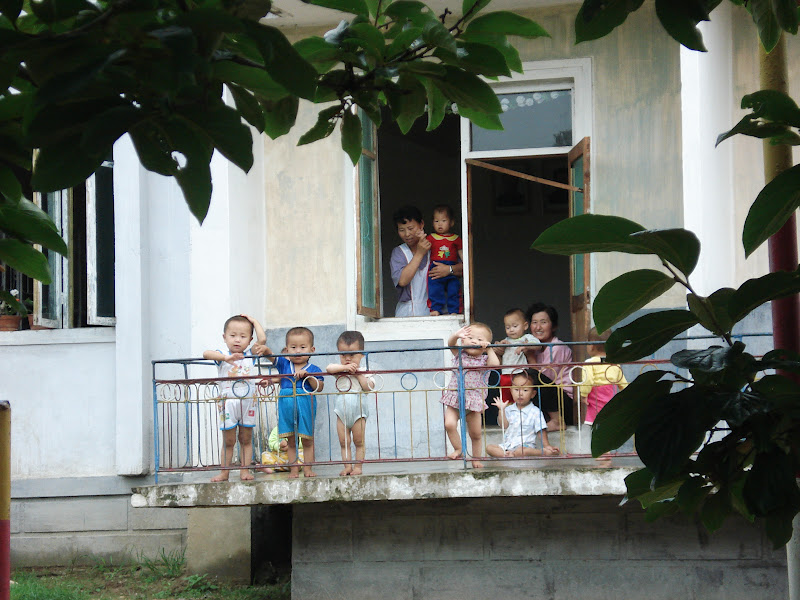
Kids at the farm's kindergarten.

They were adorable.

Farm work.


So cute! Also trained to repeatedly shout hello at foreigners when the visit. Kind of terrifying.

These two ran over when they saw us.

A kitchen in one of the nicer homes on the farm.

Fishing back at the pier.

These kids were adorable. They'd made their own can traps.

A view of Ot No (옷노 - Clothing Lake) at the Sinpyeong (신평) Hydroelectric Project Rest House..

The Rest House's obligatory portrait of the Dear Leaders.

A resort/sporting complex used by locals. Swimming and boating are regular activities here.

The tomb of King Dongmyong (동명). Dongmyeong was the founding monarch of the Goguryeo (고구려, pre-Goryo) Dynasty. He ruled while the capital was still located in China. He died in the 1st century BC. His tomb was moved to this location in 427 AD when the capital was transplanted here. The site has since been renovated.

A shrine commemorating the life, accomplishments and myths surrounding King Dongmyeong, also known by his birth name Go Ju-mong (고주몽).


Looking back toward the entryway.

The nearby Jeongreungsa (정릉사) Buddhist Temple, also rebuilt in 1993.

Buddhism is allowed to be practiced, as is Christianity, but conversion is a state crime and those who follow either religion are not allowed party membership.

One of the resident monks.

The countryside just south of Pyongyang.

Oxen are the main source of power on the farms.

The flatter countryside to the North and East of Pyongyang, visible on the train ride out.

A co-operative farm.

Kaesong! A Glimpse of Pre-War North Korea


Peeking out through the window at the Kaesong Folk Hotel.
The capital of Korea during the Goryo Dynasty (936 - 1392 AD), and with archaeological evidence stretching even further back into the Neolithic, Kaesong (개성) is a city (I use this term loosely, there are about 300,000 residents) rich in culture and history. It is also one of, if not the, only city in the DPRK where pre-Korean War traditional-style buildings remain. While all of the other cities in the DPRK were flattened by aerial bombardment during the war, Kaesong was spared by virtue of the fact that, until it was captured by the North Koreans, it had been on the South Korean side of the border. Although our movements were much more restricted here than in Pyongyang (Kaesong is located very close to the border and only 80km away from Seoul on the other side), it was definitely worth visiting. It was nice to see the different style of life. It was also great to get to stay in the North Korean version of a traditional Minbak-style guesthouse.

Traditional housing is in single rooms with mat floors located around a quadrangle.

Minbak is a no frills experience, but it's a beautiful one! Bucket showers for all.

Residents just going about their day


A pavilion a atop Mt Jaman, the central hill upon which sits the city;s Kim Il-sung statue.


A view of the city from the top. The large building is Kaesong's children's palace - the location for children to practice their extra curricular activities.
I sadly can't remember the name of this mountain, but it's very famous for resembling the profile of a sleeping pregnant woman.

Children on the hill. They were adorable, but very shy.

A view of the 13th century (rebuilt in the 17th century) Koryo Pak Mul Gwan (고려 박물관) or Confucius School, located just outside of the city. 


The reconstructed shrine leading to the tomb of the 31st King of the Goryo Dynasty, Kongmin (공민). 14th century AD.

 
Kongmin's tomb.

Just two guides hanging out.

Kongmin ruled the Korean peninsula during the era of Mongol control over Asia and, accordingly, married a Mongol Princess. The sheep surrounding their joint tombs are representative of her heritage.

These tigers (I know, I wasn't sure what they were either...) are representative of his.

Officials to attend them in the afterlife

Panmunjom & the DMZ


A sign at the entrance to a DMZ checkpoint. It reads 'Korea is One!'

A few words on the DMZ before we get back to pictures. 4km wide, 250km long and cutting the Korean peninsula in half along 38th parallel (the east end is slightly to the north and west end slightly to the south), the Demilitarized Zone is the most heavily militarized border in the world - so much so that it is not possible to cross the border and visitors wishing to enter the other country must take a detour to a third nation (usually China or Russia) first. The DMZ was established in a bid to bring an end to the Korean War with the signing of the Armistice Agreement by the North Korean forces and United Nations Command on July 27th 1953. It is important to note that South Korea and North Korea are still technically at war. The Armistice Agreement represents a stale-mate and an agreement not to bring forces withing 2km of the border on either side. As part of the agreement residents living in two villages situated within the DMZ, South Korean Daesong-dong (대성동) and North Korean Kijeong-dong (기정동), were allowed to remain under strict residency guidelines. The agreement also established the existence of the JSA (Joint Security Area) near the now defunct North Korean village of Panmunjom (판문점) where the Armistice Agreement was originally signed. The JSA is the only area where the two sides meet face to face and it is here where all agreements are negotiated and issues dealt with.

Interestingly, while tours from the South are supremely strict about dress and comportment (no flipflops or sandals, formal (or at the very least decently acceptable) clothing only, no khaki colours and nothing but your camera and passport as accessories once within the DMZ), warning you not to make sudden movements, shout or raise you hands above a certain height (many tour companies also make you sign waivers acknowledging that you could die), tours from the north are extremely lax. I went wearing shorts and sandals, definitely raised my hands above my head and spoke with the soldiers without issue. On the whole, it feels like an oddly peaceful place for all that it's a war zone.


Our wonderful army guide Second Leuitenant Kim - he was adorable and much less edgy than one would expect from a Major at the DMZ.

Entering the DMZ.
Although large tracts of the DMZ are unspoilt, the area around Panmunjom and Kaesong is used as farm land.

The 'House of Peace' building in Panmunjom where the Armistice Agreement was deliberated.

The 'Peace Museum' or 'House of Freedom' where it was officially signed.
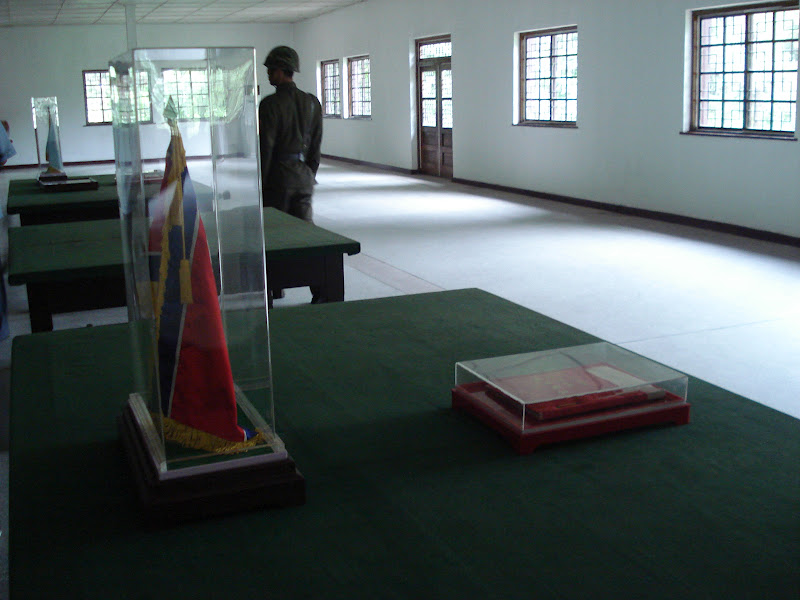
That's the Korean-language copy of the Armistice Agreement with a North Korean soldier in the background.

Looking from Freedom to Peace.


A worn-out UN flag near the English-language copy of the Agreement.


The final signature of Kim Il-sung.


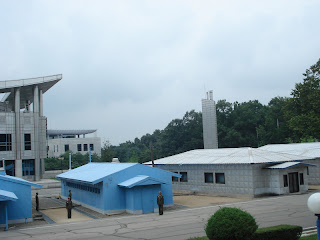
The JSA. The blue buildings are the official meeting houses and straddle the Military Demarcation Line (aka the border).


North Korean soldiers stand guard at the door leading to the South side.


A lonely southern soldier


Looking to the South Korean Freedom House Pavilion from the opposing North Korean Panmungak Pavilion.