Friday, July 13, 2012

Cycling in Gwangju

Last weekend I (finally) managed to take advantage of some gorgeous weather and the need to run errands, and went on my first true bike ride around town since arriving here. Well... I suppose that's not entirely true. Having been so excited about finally acquiring a bike and the time to use it, I also went on a bike ride the weekend previous  - in the pouring rain (sorry Jason for dragging you along!). While monsoon season was due to start a month or so ago, it only truly started two weeks ago, just in time for me to insist on riding my bike :D. It was actually a great deal of fun (I rode in the rain plenty while living in England, but never in a true downpour!). It was not, however, conducive to taking pictures. This past weekend's ride was just the opposite, with gorgeous nearly clear skies allowing for some lovely photo ops. Check out the pictures below to see some of the sights I regularly see on my bus rides into town.

Gwangju proper from the West with Mudeung Mountain in the distance.

Looking southward along the main branch of the river. This is Sangmu or 'New Downtown' district of Gwangju. (I actually live quite close to the 'NewNew Downtown' District which is quite wonderful, but of which I, sadly, have no pictures since it seems to be raining whenever I go!)
Some lovely paths and parks along the river. One of the things I love most about Korea is that no space ever seems to be wasted. Parks, sports fields and outdoor workout stations fill any available spaces - including those located under overpasses!
Crossing the river into down town after it curves eastwards.
Northward toward some high-rises that seem to permeate every Korean city.
While I thoroughly enjoyed my ride into town, it was possibly one of the most harrowing rides I have ever undertaken. I live out on the west side in an area that is separated from the rest of the city by two arms of the river and the expansive area of floodplain between then. Rather than cycling the winding route along the river, I'd decided to take the more direct route along the roads. While the freeways and overpasses were quite comfortable to cycle, with wide and well maintained cycle paths, these all but disappear on the larger, non-freeway, roads and cycling becomes either a fight not to be run down by the buses (who I previously thought only had it out for motorists and pedestrians, nice to know they choose their targets in a fair and equitable fashion :P), a jungle expedition through thick tall grass, or a game of thread the bike through the cars parked up on the sidewalk (this latter route, though time-consuming, soon became my favourite). While I've been told by many cyclist friends that my normally 45min bus ride into town is much faster on a bike, this route took me nearly 1 hour and 30 mins! I'm not sure whether this is due to my inability to cycle rapidly, the thirty-some-odd degree heat (Celsius), the amount of times I stopped for photos or the fact that I have no gears on my bike. Non-the-less, it was a thoroughly pleasant ride.

After finally making it into town and running all my errands, I saw that I still had plenty of time until dusk and decided to check out some of the sights that I had here-to-fore not had the time to see. Chief of these was 5.18 memorial park in Sangmu, which celebrates the lives and deaths of the  hundreds to thousands (the death toll is not known) of Gwangju citizens (mostly students) who took up arms from May 18th to 27th in 1980 and died fighting for democratic rights for all Koreans. Known as the Gwangju Massacre, the event and the sacrifice of the martyrs is considered significant by all Korea, with May 18th established as a national holiday. It carries a special weight here in Gwangju where the incident occurred and where many people remember the event and victims personally.

The park itself is absolutely lovely (as any park celebrating life, liberty and perseverance really should be), with lovely monuments, bike and walking paths, fountains, workout stations and shrines. The atmosphere is also supremely friendly and warm, with people greeting one another and conversing with strangers. There was even an older man playing the accordion at one of the pavilions and a group of flute playing university students at another to complete the experience. It was almost impossible to remember that one was right in the heart of downtown!
5.18 Monuments


The monument from behind.
The pagoda atop the hill in the park.
A view from the pagoda toward the Northwest where I live, you can see the flood plains behind the buildings and the "New New Downtown" area even further behind.
Looking Southwest-ward toward the 'New Downtown Area'.
Looking to the East
To the East with Mudeung and Old Downtown. Check out the storm clouds rolling in.
The lovely pagoda and fountains at the base of the park.
Riding home along this route, I also had the opportunity to ride along the floodplains which, while not exuding the prettiest scent in the world, make for some beautiful scenery.


One of the other things I love about Korea is how friendly and welcoming everyone is. After rejoining the river for the final leg of my journey home, and just as my stomach was beginning to make itself known, I was waved over by two young families (with 3 lovely children each!) who were having a barbecue under a bridge. Inviting me over and sitting me down, they ensured I was well fed as we watched the sun set over the river, stuffing me with meat, beverages, mouth watering sea food, side dishes and desert (the children were insistent that I share their cookies and fruit). Such warmth is both incredible and normal. While I was a special guest in the sense that I was a foreigner and, so, the adults had many questions for me and the kids delighted in showing me their English, many passing Koreans were waved over as well and such sharing of food is a regular practice when eating outdoors. Love it!
  
The kids playing along the river.

The bridge after sundown.

Looking toward the Wolgok-dong/Hanam area at dusk. 

Thursday, July 12, 2012

Yeosu World Expo 2012!

Last week we took the students on a post-exam field trip to the 2012 World Expo, which just happens to be taking place in the nearby port city of Yeosu (여수) located roughly 2 hours south of Gwangju. Despite the rain (and there was a lot of it. It managed to permeate my umbrella so that I was soaked through before I even made it to school to catch the bus!), it was a pretty cool day. This year's expo theme is "The Living Ocean and Coast", so what better place to host it than in a port city?


Excited students below Yeosu's Digital Aquarium
Rather than wandering around with the other teachers, I decided to tag along with different groups of students - definitely a wise choice, as getting to see the excitement on their faces at the aquarium was pretty awesome, as was watching their delight when they started catching crabs by the shoreline (I left some a group of boys after about 10 minutes of this only to return an hour later to find that, not only were they still there crab-hunting, they'd been joined by a great many of the other boys. Funnily, they kept complaining to me every time one of them got pinched by a claw :P).

Hunting for crabs.

Got one!

As we were only at the expo for 6 hours (shame, that, there is a great deal to see!), I didn't have the opportunity to check out too many of the national pavilions in the international area. Those which I did see and which are worth visiting included Japan, Switzerland and France. Japan's pavilion used animation to tell the story of hope after it's recent Tsunami-induced disaster. While the story is a bit contrived (there are English subtitles) the stunning 3D holographic animation in which it is told makes the experience breathtaking. There are long lines for this, so pick up your ticket (at the Japan pavilion) in advance. The Swiss exhibit was made wonderful by the inclusion of a glacial ice core and information surrounding environmental data collection. Definitely cool to see. France I just liked for the inclusion of jelly fish and a cute colourful aquarium at the entrance. 

An Ice Core as old as Korea at the Swiss Pavilion.

The French Pavilion.
My main focus of the day was on exploring the theme pavilions (and watching my students catch crabs). My two favourites of the ones I managed to explore were the Marine Industry & Technology Pavilion, which primarily involved a hilariously k-pop-y discussion of the benefits of kelp set in a future undersea laboratory (I got the feeling the presentation was mainly geared towards kids - English subtitles once again) and the Expo's 'Eco-Friendly' Aquarium containing 34,000 animals of 281 different species . While I'm not usually a huge fan of seeing animals in captivity and would have preferred to see the Baikal Seals and Belugas in larger tanks, the aquariums 360° Aquadome was fantastic. What can I say, I was won over by having sea turtles, hammerheads and a number of other large marine species swimming directly over, under and around me :).


Solar Panels at the Aquarium.

The reaction of my students when they realized that he was not, in fact, a statue.
(It involved a lot of excitement and screaming)

Their excitement at the solar-powered charging station.
Our faces projected onto the aquarium walls.
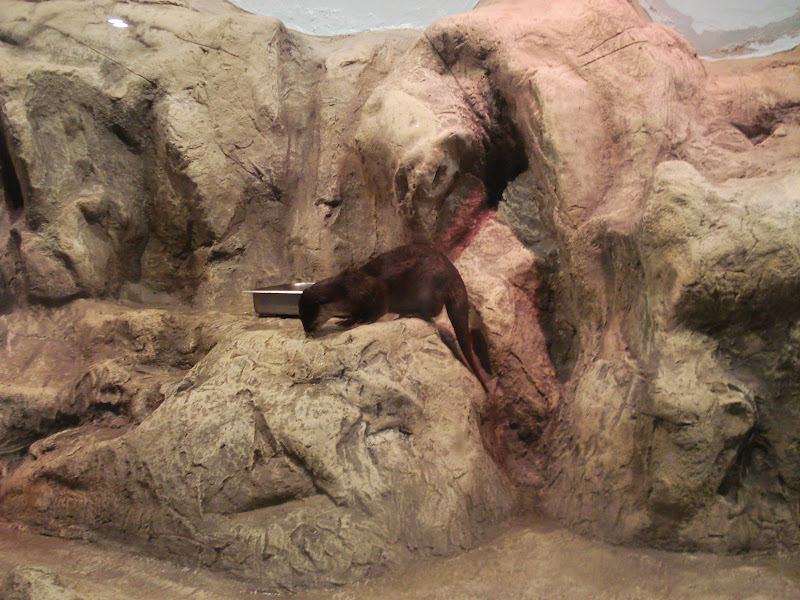
An Asian river otter. 
The piranha tank. This caused a great deal of confusion as my students refused to believe, when I told them in both English and Korean, that these tiny fish ate people. The English sign reading "Man-eating piranha" which my students read as though there was no hyphen was of no help. The reaction when I finally dragged them over to the Korean sign was doubly hilarious because of this :D.

A giant clam.
The orange dot you see peaking out of the clam is actually a small fish that seemed perfectly content to be in there whether the clam was closed or open.

Jelly fish!
A view of the 360 Aquadome from outside.
Inside the dome.


Oyster Farms
While the rain, sadly, kept me from staying for the evening's free K-Pop concert (I decided instead to catch the bus home with my school - shame, it would have been nothing short of awesome to have seen 2PM and miss A live), the sky did clear around midday, allowing us to catch the Korean culture and talent show occurring out near the 'Big O'.


Yes, those are real live girls swaying on bamboo poles!


All in all, it was a pretty great day. I definitely recommend going if you get the chance - although chances are limited since the expo period ends on August 12th (it's been on since May). Single day tickets are 33,000won, double days are 53,000. All concerts are free for ticket-holders and there are a number occurring on any given day. I recommend going on a weekday as weekends can get pretty busy and lines will be long. For more info on the expo, please click here. For a map & pavilion details, click here. For a listing of K-Pop concerts occurring on the ground, click here. Note that there is a free bus to the expo departing from and returning to Gwangju. I don't have any of the details. I do, however, know that seats must be booked 3 days in advance. 

Friday, July 6, 2012

Seoul Base Camp Hostel

While I'm sure you're all sick of Seoul-related posts, after nearly 7 weeks away, It was time for me to head back to the capital. What can I say, dance, friends and family exert a strong pull  ^_~.  Alongside my usual activities, I also had the opportunity to check out a fantastic new hostel.

Seoul Base Camp Hostel is located about 10 steps south of Exit 8 of Hapjeong Subway Station (합정역). Placing it at short 15minute walk from the heart of the vibrant Hongdae area.  Run by Min and Jake, this hostel has a great vibe and hosts who speak English. The space was formerly an old time-y dance hall (apparently they occasionally still get some of the older clientele dropping by looking for some swing dancing!) and I love what they've done with it. Rather than put up walls, they've used canvas to give the place a vast tent-like feel. Their wooden-cubby beds act like noise and light dampeners to ensure that you get a peaceful night's sleep. They also have normal bunks for those wishing for a wider, less enclosed sleeping space. More important to many visitors to Seoul, the Base Camp also offers a roof top terrace and (soon to be implemented) roof top bar offering one free beer per night to all guests, in addition to a (soon to be finished) hot tub. Follow up a great night with Min's delicious (and free) waffles in the morning for breakfast and you've got the perfect hostel! Check out the pictures below and be sure to look them up on Facebook, Google or their shiny new website at SeoulBaseCampHostel.com if you are interested in staying. The price is pretty low at present as they do not yet have the above mentioned features up and running, but that makes it even more worth the visit!


While the Base Camp experience was well worth the trip to Seoul in itself, what would a trip be without a little more exploration!

Although I've spent much of my Seoul-time in the Hongdae area, walking around with MinJung on this past trip, I spotted something I'd failed to notice before. The "Luxury" Norebang (singing room) chain has huge windows through which you can watch patrons as they belt their hearts out! I never would've noticed had it not been for the crowd of local Koreans snapping pictures. Couldn't get close enough to snap a clear shot, but check out this guy's moves below!


In addition to spending more time in Hongdae, I got to check out Dongdaemoon (동대문), or the "Great Eastern Gate" -  also called Heungjinmoon (흥진문), or "The Gate of Rising Benevolence".

The gate was initially built in by King Taejo of the Joseon (pronounced Chosun) Dynasty in 1398, was renovated in 1453, and then finally rebuilt in 1869 (presumably after it's destruction by the Japanese) and served as the Eastern passage through the city walls during the Joseon Period.


We also decided to explore the area to the west of Gyeongbuk Palace and to the East of Hongdae a bit more thoroughly as neither my friends nor I had ever been.


We discovered a few delights such as the statue above, the old streetcar below, and the Seoul Museum of History (which I sadly did not have time to explore).


There was also a lovely little covered excavation preserving storefront layout from the Joseon.


Also over this way is the much quieter and quainter Gyeonghuigung (경희궁), or Palace of Serene Harmony. A great place to go for a break from the busy-ness of Seoul, Gyeonghui was built to harmonize with the surrounding landscape, giving it a wonderfully peaceful air. This is also helped by the fact that it's the smaller sibling of the other 4 great Joseon palaces and, so, was nearly empty of tourists when we visited. Entry is also free.


Apparently hour-long Taekwondo demonstrations are regularly held on the grounds. Sadly, we didn't manage to catch these.

Next, it was time for me to dash down to the Sinsa (신사 - pronounced Shinsa) area to meet up with some family. While I don't have any pictures. The area is a lovely part of town, and well worth visiting. Its filled with quaint boutiques and larger unobtrusively placed chain stores. Perfect for shopping. It was here that I also finally managed to try Korea's summer specialty: Naengmyun (냉면) or, literally, cold noodles.

Yes, those are, in fact, ice cubes you see floating in my soup!